

Mauzy Properties · Twin Cities single-family rental management
School started a couple of weeks ago, and if you've had a house on the market since June, you probably felt the change before you saw it in the numbers. Showing requests thin out. The weekend traffic that used to be six groups has become two. Nobody's telling you no — they've just stopped coming.
That's not your house. That's the calendar. Families with school-age kids compress their entire move into the window between the last day of school and the first, and that window is closed. The buyers still shopping in October are a smaller, more patient, more price-sensitive group, and they know the listings they're looking at have been sitting.
So you're facing the question a lot of Twin Cities owners are facing right now: cut the price and sell into a thinning market, rent it out, or pull the listing and try again in the spring?
We ran the actual numbers. The answer surprised us a little.
First, What the Market Is Actually Doing
Worth separating the seasonal slowdown from a market decline, because they get conflated constantly, and they call for opposite responses.
Through July 2026, the Twin Cities median sale price was $408,000 — up 3.3% year over year. Homes sold in a median of 40 days, essentially flat, and sellers received about 99% of the original list price. Inventory rose to 11,586 units, up 6.7% and a roughly seven-year high, with months supply at 3.0.
Read that together: values are holding, but there's more competition than there has been in years, and buyers have time. Then layer autumn on top of it. Prices aren't falling. Your audience is shrinking.
One more number, because it kills the most common reason people give for waiting: the 30-year fixed averaged 6.76% in the week ending September 10, up from 6.35% a year ago. Anyone who held off last fall, expecting cheaper money, is now facing a higher rate and another year of carrying costs. "Wait for rates to drop" is a bet, not a plan.
Option 1: Cut the Price and Sell Now
The honest case for this: it's over. You get your equity, you stop carrying the house, and you stop making decisions about it.
The honest case against: you're selling into the weakest pricing window of the year. ATTOM's 2026 analysis — 52 million single-family and condo sales from 2015 through 2025 — puts the average seller premium at 7.9% above automated market value in October, the lowest of any month. March is the strongest at 10.7%, with April and May close behind at 10.2%.
That's a national, long-run average, not a guarantee for your specific house. But the direction is consistent, and on a $400,000 home, the spread between an October sale and a spring one works out to roughly $9,000 to $11,000.
If you need to be out — job relocation, you've already closed on the next house, the equity is doing something specific — take it and don't look back. Certainty has real value, and this post won't talk you out of it. But if the only reason you're considering it is that you're tired of the listing, keep reading.
Option 2: Pull the Listing and Wait for Spring
This is what most owners instinctively want to do, and it's where the math is at its worst — because it's the only option in which the house produces nothing for seven straight months.
Here's the carrying cost on a $400,000 Twin Cities property, before your mortgage:
| Item | Monthly |
|---|---|
| Property taxes (~1.1%/yr, Hennepin/Ramsey) | $367 |
| Vacant-home insurance | $150 |
| Utilities — you must heat it | $150 |
| Lawn and snow removal | $100 |
| Maintenance reserve | $75 |
| Non-mortgage carry | $842 |
Over October through April, that's about $5,900 out of pocket — on top of every mortgage payment, and that's the piece people forget because they're only counting the mortgage.
Now weigh it against the $9,000–$11,000 seasonal upside. You're spending real cash and taking on seven months of risk — a furnace that quits in January, a frozen pipe in a house nobody's checking, a spring market that doesn't look like you assumed — to capture a premium you could get anyway under option three.
That's the problem with waiting. It isn't that the spring premium isn't real. It's that sitting empty is the most expensive way to get it. An unoccupied house generates nothing and constantly consumes.
Option 3: Rent It Through the Winter — On a Lease That Expires Into Spring
This is the one most owners don't consider, and it's the one that wins.
The insight is that "rent it" and "sell in the spring" are not mutually exclusive. They only conflict if you sign a standard twelve-month lease, which locks the house up until the following November — the worst possible month to list.
Instead, sign a shorter bridge lease. A six-month term starting November 1 ends April 30. You use October to get the house ready, place a tenant, collect rent throughout the entire dead season, get the keys back in spring, and list it during the strongest pricing window of the year.
Here's how that runs on the same $400,000 home. Note that a tenant pays the utilities and handles lawn and snow, so your carrying costs drop too:
| Monthly | |
|---|---|
| Market rent (Twin Cities single-family) | $2,200 |
| Less flat management fee | −$100 |
| Less property taxes | −$367 |
| Less landlord insurance | −$150 |
| Less maintenance reserve | −$150 |
| Net to you | $1,433 |
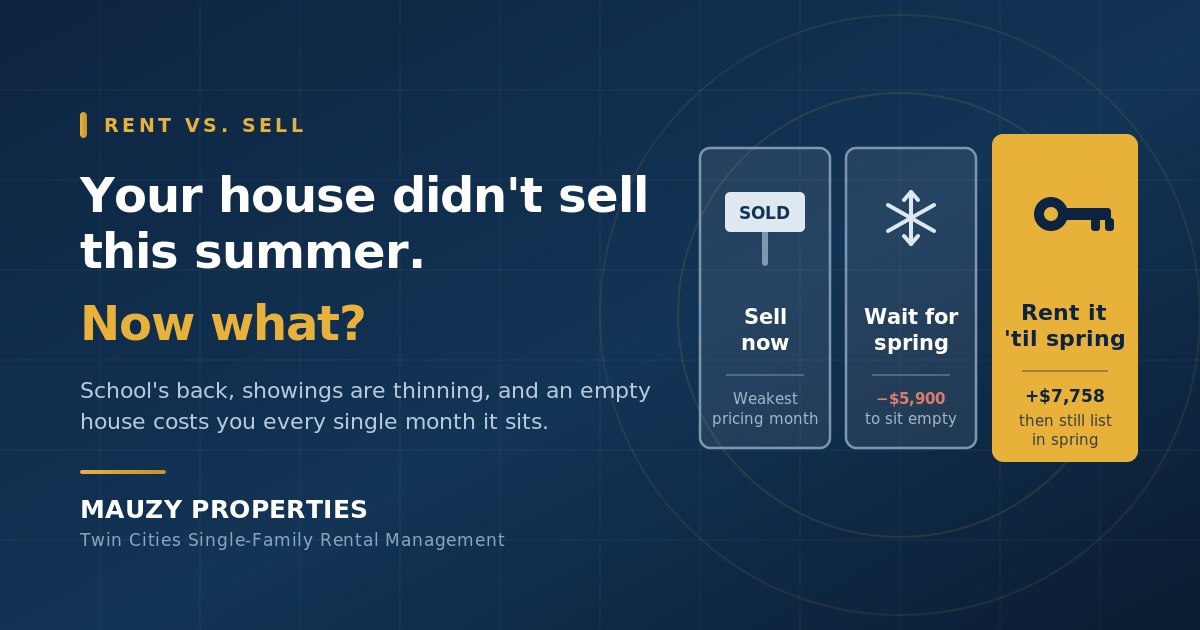
Six months of that is +$7,758 after accounting for October being vacant — compared to −$5,892 if you leave it empty. The swing is roughly $13,650.
And here's the part that settles it: the spring premium is available either way. Both options put you on the market in the spring. One of them pays you $13,650 to get there.
You don't have to choose between renting and selling. You just have to pick the right lease term.
The Honest Caveats
This is the part most articles leave out, and you should weigh it all before deciding.
Short leases rent for less. A six-month term draws a smaller pool than a twelve-month one and typically prices $100 to $200 under market. Build that into your expectation — it's a discount, not a dealbreaker. It also means the tenant needs to understand from the first showing that this is a fixed-term arrangement.
You have to list it as vacant. Selling a tenant-occupied home is harder, shows worse, and complicates access. The bridge lease has to genuinely end before you list, which means being disciplined about the term and clear with the tenant from day one that renewal isn't on the table.
Your insurance has to change. A homeowner's policy is written for the house you live in. Once a tenant moves in, carriers can deny a claim outright. You need a landlord policy even for six months, bound before the tenant moves in.
The tax clock starts. Renting a former primary residence begins the countdown on your Section 121 capital gains exclusion — you generally have about three years from move-out to sell and still qualify. A six-month lease barely touches that window, which is exactly why the bridge approach works and an indefinite "just rent it for a while" doesn't. Talk to a CPA either way.
Winter turnover is real work. Make-ready in Minnesota between November and March is slower and more expensive than in July, and you need a tenant placed before the weather turns, not after.
The seasonal premium is an average. ATTOM's figures are national and span 2015–2025. Your neighborhood, your price point, and next spring's specific conditions will all differ.
What We'd Tell You If You Called
If you have to be out, sell now and take the certainty. Don't let a $9,000 maybe talk you into seven months of carrying a house you needed to be done with.
If you're only waiting because you're tired of the listing, don't sit on an empty house to do it. You'd be spending roughly $5,900 in cash, and seven months of risk to reach a spring market you could reach with a tenant in place and $13,650 more in your pocket.
For most owners in this spot, the bridge lease is the strongest play: it converts your most expensive months into your only revenue-positive ones, and it still puts you on the market in spring.
And if the rent number comes back strong enough, some owners look at the math and decide not to sell at all. That happens more often than you'd think once they see what the house actually produces.
Our Rent vs. Sell calculator will run your specific property in a couple of minutes. If you'd rather just have a real conversation about what your house would rent for this fall — and whether renting or selling is the better move — talk to our team or call 612.367.7848.
We manage single-family homes across Minneapolis, St. Paul, and the metro for a flat $100/month, and we'll tell you honestly if selling is the better answer. We'd rather be right than get the listing.
Mauzy Properties · 19950 Dodd Blvd., Suite 102, Lakeville, MN 55044 · 612.367.7848 · info@mauzyproperties.com
Market data: Minneapolis Area Realtors Monthly Indicators, July 2026 (Twin Cities region, NorthstarMLS); Freddie Mac Primary Mortgage Market Survey, week ending September 10, 2026; ATTOM Data Solutions "2026 Best Days to Sell a Home" (52M+ sales, 2015–2025); Zumper rent research, September 2026; Tax Foundation 2026 property tax data. Carrying-cost and rent figures are illustrative estimates for a representative $400,000 Twin Cities single-family home — your actual numbers will differ.
This article is general information for Minnesota homeowners, not legal, tax, or investment advice. Consult a CPA about the capital gains implications of converting a primary residence to a rental, and an insurance agent before a tenant moves in.