

Home Warranties on Rental Property: What They Actually Save You
Mauzy Properties · Twin Cities single-family rental management
Every month, we file warranty claims on behalf of owners who carry home warranty or utility appliance plans. We've done it enough times to have a clear view of what these programs deliver, and it isn't always what owners expect when they sign up.
This isn't an argument that warranties are worthless. For some owners, they're the right call, and we'll get to which ones. But the savings owners predict when they buy a plan are often not the savings they get, and the cost that never shows up on an invoice is the one their tenant pays.
The math is closer than the sales page suggests
Home warranty plans generally run $350 to $900 a year, with comprehensive tiers landing toward the top of that range, and most charge a per-visit service fee of $75 to $125 on top of the premium. Utility appliance plans are cheaper — Xcel's HomeSmart has historically been priced at around $20 per month for four large appliances, though Xcel no longer publishes rates and instead quotes them individually.
Now the other side of the ledger. Most of what actually breaks in a rental is routine: an ignitor, a capacitor, a thermocouple, a blower motor. Across our portfolio, the typical repair invoice on those items is a few hundred dollars. Across the homes we manage, our average furnace repair invoice in 2025 was $290.
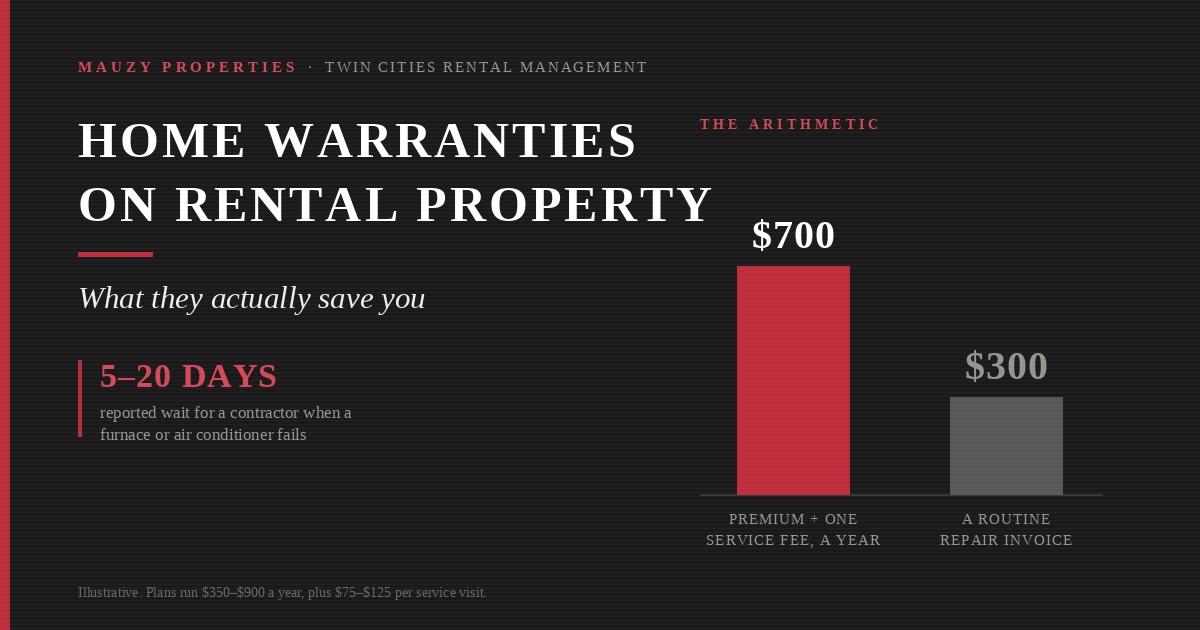
So an owner paying $600 a year in premiums plus a $100 service fee has spent $700 to avoid one repair of a few hundred dollars. Two covered repairs in a year get them to roughly break even. One quiet year and they're behind.
That's the arithmetic on routine work. The pitch, of course, isn't really about routine work.
The expensive failures are the ones most likely excluded
This is the part that catches owners off guard. The catastrophic failures a warranty is meant to protect against are frequently the exact components carved out of coverage.
You don't have to take our word for it — it's in the contracts. Xcel's own HomeSmart terms and conditions exclude the furnace heat exchanger, the air conditioning compressor and its refrigerant lines, refrigerator water and ice dispensers, refrigerators located in unconditioned spaces like a garage, and ceramic or glass cooktops. A cracked heat exchanger or a failed compressor isn't a routine repair. It's usually the failure that forces a replacement running several thousand dollars.
To be fair to Xcel, its optional Replacement Assistance Plan does offer reimbursement toward exactly those failures — but read the schedule. It pays $1,000 toward a furnace, $1,800 toward a boiler, $1,000 toward a central air conditioner, and $450 toward a water heater. Against a Twin Cities furnace replacement, $1,000 is a contribution, not a solution.
Read it all together, and the structure becomes clear. You're paying a premium that comfortably covers the failures you could have absorbed, and receiving partial help on the failures that would actually hurt.
Waiting periods compound it. HomeSmart's terms treat anything that arises within the first 30 days as a pre-existing condition — it will still send a technician, but the work is billed at regular rates. Choice Home Warranty coverage begins 30 days after enrollment unless you can document prior continuous coverage with another carrier. An owner who buys a plan because the furnace is making a noise has generally bought nothing.
What your tenant experiences
Here's the cost that never appears in a comparison chart.
When a warranty covers a repair, the work doesn't go to our vendor. It goes to whoever the warranty company's contractor network assigns, on that network's timeline. In peak season, those timelines stretch.
Star Tribune reporting in 2019 examined complaint patterns for HomeSmart and CenterPoint's Service Plus and found waits of five to 20 days when a furnace or air conditioner failed. A Minneapolis homeowner was told it would be ten days for a technician during a July stretch of 90-degree days; she hired an independent tech who came the same day. A Brooklyn Center resident waited another ten days after the first technician never showed. No-shows were described as a common complaint after customers had already given up a day of work for an eight-hour arrival window. That reporting is several years old, but the underlying dynamic — a fixed contractor network meeting a seasonal demand spike — hasn't changed, and it matches what we still see in January and July.
Put that in a rental context. Your tenant reports no heat in January. We file the same day. The network assigns a contractor in two days; that contractor offers an appointment six days out, and your tenant is looking at more than a week in a cold house. During that time, they are calling us, and we have no authority to move a contractor we didn't hire.
Then there's the service fee. Someone has to hand $100 to the technician at the door, and if that hasn't been arranged in advance, your tenant finds out on the doorstep.
Tenants don't file this under "my landlord was being fiscally prudent." They file it under "nothing gets fixed here." A single turnover — vacancy, make-ready, leasing — costs most owners more than several years' worth of repairs, a warranty was meant to avoid. That trade is rarely part of the calculation, and it should be.
The four programs we work with most
These are not interchangeable, and it's worth being specific.
Xcel Energy HomeSmart is the best-structured of the four in terms of per-incident cost, marketed as carrying no separate trip, labor, or parts charge on covered repairs — so there's no service fee to argue about at the door. The trade-offs are the exclusions above, the 30-day pre-existing-condition rule, and a 12-month auto-renewing term you can only cancel in a narrow window around the anniversary date, by contacting HomeSmart directly rather than Xcel. Coverage is also enrolled on an appliance-by-appliance basis, so "I have HomeSmart" doesn't tell us whether the water heater is on the plan.
Cinch Home Services carries a 180-day workmanship guarantee, which is genuinely useful when a repair fails. But its published guidance for real estate professionals states that on tenant-occupied single-family homes, the homeowner is responsible for requesting service and paying the deductible. That's worth resolving with us in advance rather than mid-outage.
American Home Shield lets owners choose a service fee — its published sample agreement offers $100 or $125 — trading premium against per-visit cost, and its app and portal are the best of the four. One term deserves attention: use a contractor AHS hasn't approved in writing beforehand and the agreement states you get no reimbursement at all, even on an otherwise covered breakdown.
Choice Home Warranty charges a $100 trade service call fee per claim, regardless of repair cost, and offers a genuinely 24/7 claims line. But also turns out to be the toughest to schedule with.
When a warranty does make sense
It's a reasonable choice if the home has aging systems you can't afford to replace out of pocket right now, if you don't have a repair reserve and would rather smooth costs into a monthly payment, or if you own from out of state with no local vendor relationships. Predictability has real value even when the expected return is negative — that's true of most insurance.
What it usually isn't is a savings strategy. Owners with a funded reserve and a good HVAC vendor tend to come out ahead, paying for repairs directly, and their tenants get service in days instead of weeks.
If you already carry a plan, do one thing
Add us to your warranty account as an authorized contact.
The account is in your name, which means when your tenant reports a failed water heater, we often can't open a claim until we've proven we're allowed to discuss your account at all. That single hurdle adds days to repairs that are otherwise fully covered. One fifteen-minute call with you and your provider removes it permanently.
Weighing a plan on a Twin Cities rental, or trying to work out whether the one you have is earning its premium? Send us the property address and the ages of the furnace, water heater, and A/C, and we'll give you a straight answer — including when the warranty is the right move.
Sources: Xcel Energy HomeSmart terms and conditions · Xcel HomeSmart Replacement Assistance terms · Cinch Home Services real estate FAQ · American Home Shield sample plan agreement · Choice Home Warranty FAQ · Star Tribune, "Don't let home appliance-repair contracts trip you up" and "Six things you need to know about your HomeSmart, Service Plus appliance contract", November 2019. National warranty pricing reflects published 2026 industry surveys. Plan terms vary by tier, state, and contract year; your own plan documents govern.