

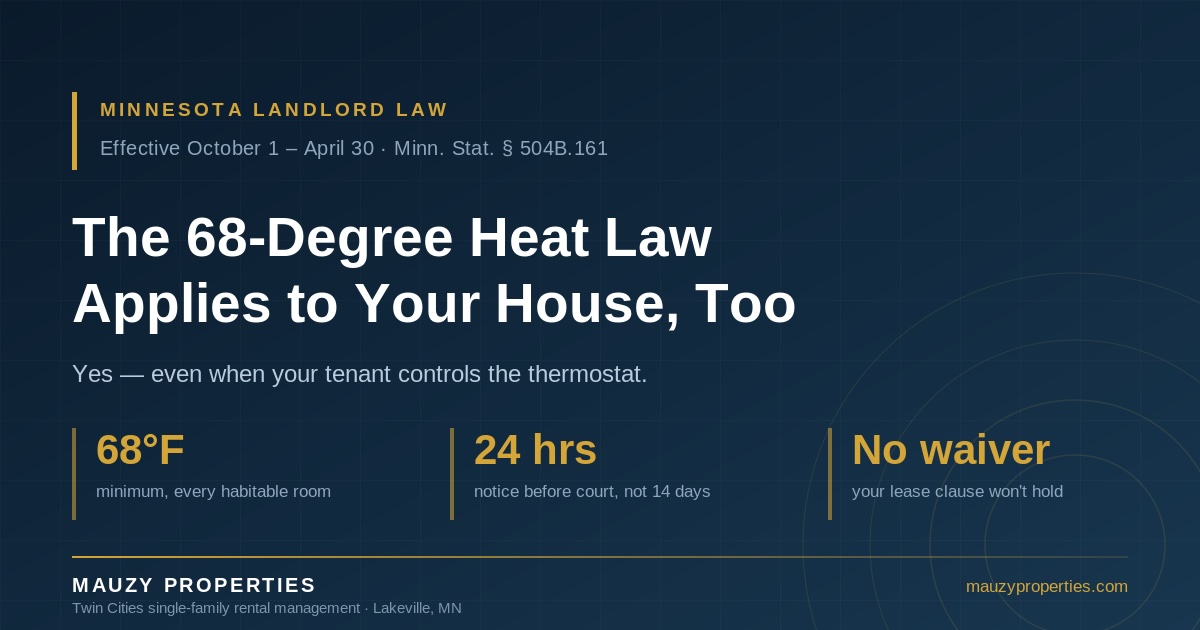
October 1 is next week. On that date, a Minnesota statute that most single-family rental owners believe applies only to apartments begins to apply to their houses and remains in effect until April 30.
We raise this every fall and get the same answer: my tenant controls the thermostat, so this doesn't apply to me. That's the most common misreading of Minnesota landlord law we encounter — and the legislature rewrote the provision in 2025 in a way that makes it worse for owners who believe it. Here's what the statute says, what changed, and which clause in your lease won't hold up.
What the Statute Actually Requires
Minn. Stat. § 504B.161, subd. 1(a) lists covenants that exist in every residential lease in Minnesota, whether or not anyone wrote them down. Clause (5) is the heat one:
"to equip or furnish heat at a minimum temperature of 68 degrees Fahrenheit in all places intended for habitation including kitchens and bathrooms from October 1 through April 30, unless a utility company requires and instructs the heat to be reduced."
Three things to notice.
"Every lease or license of residential premises." Not every apartment building, and not only properties carrying a rental license. A single-family house in Lakeville is a lease of residential premises, and so is a townhouse in Plymouth.
"Equip or furnish." The 2025 change, and the one that matters. The prior version read "supply or furnish"; Minnesota's 2025 housing act (Laws 2025, ch. 32, art. 4, § 4) struck "supply" and put "equip" in its place.
"In all places intended for habitation including kitchens and bathrooms." Also new in 2025. The old text just said 68 degrees. The current text tells you where. It took effect July 1, 2025, making this the second heating season under the rewritten language.
"But My Tenant Controls the Thermostat"
Here's where "equip" does its work, and where most owners have it backward. The statute imposes two duties joined by "or," and which apply depends on who controls the heat:
If you control the heat — a boiler you run, heat included in rent — you must furnish 68 degrees. Actually deliver it. If the tenant is sitting at 61, you're in violation.
If the tenant controls the thermostat — nearly every single-family rental in the metro — you must equip the home with a system capable of maintaining 68 degrees in every habitable room, including kitchens and bathrooms.
So the popular conclusion is inverted. Tenant control doesn't exempt you; it changes your duty from furnishing heat to equipping the house to produce it — a condition of the property year-round, not something you satisfy by answering a January complaint quickly.
In practice: if the furnace runs fine but the back bedroom over the garage sits at 58 all winter, the house is arguably not equipped to maintain 68 in all places intended for habitation. The system running isn't the test — the temperature it holds in each room is. That problem is common in the older suburbs' 1950s–70s stock, and it's what an owner-occupant lives with for years: shut the door, add a space heater. A tenant isn't obligated to do that.
The Clause in Your Lease That Won't Hold Up
Pull up whatever lease you're using. If it came from a template site, there's a good chance it says something like "Tenant is responsible for maintenance of the heating system." As applied to the heat covenant, that's unenforceable — two provisions kill it.
Subdivision 1(b): "The parties to a lease or license of residential premises may not waive or modify the covenants imposed by this section." Not unless both parties agree. May not waive, period. A signature doesn't help.
Subdivision 2 traps careful owners. It does let you shift specified repairs to the tenant — but only if the agreement is "supported by adequate consideration and set forth in a conspicuous writing." Then it adds: "No such agreement, however, may waive the provisions of subdivision 1."
So you can validly agree the tenant mows and shovels, provided you pay for it and the term is conspicuous. You cannot make the tenant responsible for the furnace, no matter what you pay or how bold the font. The Attorney General's handbook puts it plainly: the repair covenant "cannot be waived by a tenant, meaning that even if the lease says that the tenant must perform maintenance or repairs it is not enforceable." Give a rent reduction for furnace responsibility and you're paying for a promise no court will enforce.
What It Costs When the Heat Fails
Rent escrow. Under § 504B.385, a tenant gives written notice, waits 14 days, and if it isn't fixed, deposits rent with the court administrator instead of paying you. A hearing follows in 10 to 14 days. Under § 504B.425, the court can order repairs, let the tenant repair and deduct from rent, abate or refund rent, appoint an administrator to collect your rent, or fine you.
Emergency action. Loss of heat is named in § 504B.381 as grounds for an emergency tenant remedies action. The tenant must attempt to notify you 24 hours before going to court — not 14 days or even 1 day — and if you can't be reached, the court can issue an order with no notice at all.
The tenant can leave. Under § 504B.131, a tenant of a building that becomes uninhabitable through no fault of their own "may vacate and surrender" it; the Attorney General reads that as ending the obligation to pay further rent. An uninhabitable house in January is an unrentable one until spring.
Retaliation exposure. Under § 504B.441 you can't raise rent, cut services, or file an eviction as a penalty for a tenant contacting an inspector — which is exactly how an owner who feels ambushed turns a repair bill into a lawsuit.
Then there's the damage. A furnace that quits in January isn't just a comfort problem — it's a burst-pipe problem. Per the Insurance Information Institute, water damage and freezing is among the most frequent homeowners claims: about one in 67 insured homes files one in a given year (2019–2023 average), and over 2018–2022 those claims averaged roughly $13,954. Replacing a furnace in the metro generally runs $4,800 to $7,700 for a standard gas unit based on advertised pricing. Put those side by side: a furnace is a four-figure expense you can schedule. A burst-pipe loss is a five-figure claim you can't, and it comes with a deductible, a claims history, and a house nobody can live in.
The Covenant Nobody Talks About
While you're in the statute, read subdivision 1(a)(3) — the weatherization covenant, which we almost never hear owners mention. You're obligated to make the premises "reasonably energy efficient by installing weatherstripping, caulking, storm windows, and storm doors," where the savings would exceed the measure's cost, amortized over ten years. That's a real qualifier, not a blanket mandate — but in Minnesota, weatherstripping a leaky door and caulking old windows clears it without much argument.
One more date, if you own a duplex: where the building is "shared-metered" and you bill tenants for gas or electricity separately from rent, § 504B.216, subd. 15 requires an annual written notice about energy assistance, with the agency's toll-free number, by September 30. That's this month.
Why This October Is a Bad One to Get Wrong
There are more first-time Minnesota landlords heading into this winter than usual, and the market explains why.
In August 2026, the Twin Cities median sales price was $405,000, up 1.3% year over year — prices are holding. But homes took an average of 45 days to sell, up 7.1%; new listings rose 8.2% to 6,481; and metro inventory climbed 7.9% to 11,698 units. Freddie Mac put the 30-year fixed at 6.95% for the week ending September 17, up from 6.26% a year ago and the highest since January 2025.
Houses are sitting on the market longer, competition is up, and financing has gotten more expensive. A predictable share of owners who couldn't sell this summer are renting instead — often the right call, and we've made that case ourselves. What gets skipped is that renting attaches these covenants on day one. If it's your first winter as a landlord, the furnace is no longer something you handle when it bothers you. It's a legal obligation with a 24-hour clock.
The Honest Caveats
"Equip" hasn't been litigated much. The word is barely a year into the statute, and we're not aware of any significant Minnesota appellate case law reading it in the tenant-controlled-thermostat context. Our reading — a capability standard on the heating system — follows the plain text, but a court could read it more narrowly.
And there's a wrinkle in the legislative history. The 2025 housing act, as enacted, reads "equip or furnish heat capable of maintaining at a minimum temperature of 68 degrees." The 2025 corrections act (Laws 2025, 1st Spec. Sess., ch. 11, § 1) then struck "capable of maintaining." We read that as a grammar fix — the original phrasing was ungrammatical, and a corrections act exists for exactly that — but opposing counsel could argue the legislature deliberately backed away from a capability standard. Another reason to get your own advice rather than rely on ours.
Local ordinances stack on top. Subdivision 4 says these covenants are in addition to anything imposed by ordinance — Minneapolis and St. Paul both maintain their own housing codes and rental licensing.
Tenant conduct is a defense, within limits. Clauses 1(a)(2) and (4) carve out disrepair caused by the "willful, malicious, or irresponsible conduct" of the tenant, so if a tenant sets the thermostat to 50 and pipes freeze, you have an argument. But that carve-out does not appear in the heat clause (5). It cuts both ways: clause (2), which does carry it, covers the services listed in § 504B.381, subd. 1 — and that list includes loss of heat. Genuinely contestable in both directions.
The cost figures are ranges, not quotes. And we manage property; we don't practice law.
What We'd Tell You If You Called
Three things before October 1.
Get the furnace serviced and get the report in writing. Not because a tune-up is legally required, but because documentation that the system was inspected and working protects you if a tenant later claims the house was never adequately heated. A service record dated September is worth a lot in February.
Walk the house with a thermometer, not your memory. Check the rooms you never think about — over the garage, the finished basement, the addition, the upstairs bathroom. If a habitable room can't hold 68 with the system running, solve it now while HVAC contractors are still answering the phone.
Delete the furnace clause from your lease. It's unenforceable, and its presence signals to a judge that you didn't know the rules. Keep the lawn and snow terms if they're properly written and paid for.
And the unflattering version, since we'd rather say it than have you find out in January: if this post was the first you'd heard of the 68-degree covenant, the 24-hour clock, or the weatherization provision, the heat law probably isn't the only obligation you're missing. There are about a dozen more with similar teeth. That's fixable — plenty of owners self-manage well — but it's worth deciding on purpose whether you want to be the one tracking it.
We manage single-family homes across Minneapolis, St. Paul, and the metro for a flat $100/month, basic handyman work included. We keep an in-house maintenance team rather than outsourcing, which is why we can get to a no-heat call the same day instead of putting you in a vendor queue during a cold snap.
Want someone to look at your property before the cold sets in? Talk to our team or call 612.367.7848. Our Owner FAQs and first-time landlord guide are free either way.
Mauzy Properties · 19950 Dodd Blvd., Suite 102, Lakeville, MN 55044 · 612.367.7848 · info@mauzyproperties.com
Sources: Minn. Stat. § 504B.161 (2025) and §§ 504B.131, 504B.216, 504B.381, 504B.385, 504B.425, 504B.441, Minnesota Office of the Revisor of Statutes; Laws 2025, ch. 32, art. 4, § 4, and Laws 2025, 1st Spec. Sess., ch. 11, § 1; Minnesota Attorney General, "Landlords and Tenants: Rights and Responsibilities"; Minneapolis Area Realtors Monthly Indicators, August 2026 (Twin Cities region, NorthstarMLS); Freddie Mac Primary Mortgage Market Survey, week ending September 17, 2026, and PMMS archive; Insurance Information Institute homeowners claims data (claim frequency 2019–2023; claim severity 2018–2022). Repair cost figures are illustrative ranges based on advertised metro pricing, not quotes for any specific property.
This article is general information for Minnesota rental property owners and is not legal advice. Minnesota landlord-tenant law is detailed and changes frequently, and how a statute applies depends on the specific facts of your property and lease. Consult a Minnesota attorney about your lease and your obligations, an insurance agent about your landlord policy before a tenant occupies the home, and a licensed HVAC contractor about your heating system's capacity.