

Mauzy Properties · Twin Cities single-family rental management
October rent is due Thursday. For most Twin Cities owners, that means a portal, an app, or a Zelle notification, and nobody thinks about it until something breaks.
On August 1, 2026, a short law called Chapter 81 rewrote Minn. Stat. § 504B.118. It used to be a one-line rule about receipts for cash rent. It's now a section called "Payment of Rent," it controls what happens when your digital payment system goes down, and it gives tenants a defense that can get a non-payment eviction thrown out, with the owner paying the tenant's attorney fees.
October 1 is the third rent day under the new rule. The owners most likely to miss it are the ones who rented out a house this year because selling didn't pencil out.
The backdrop: more accidental landlords, collecting rent in more ways
In August, the Twin Cities median sale price was $405,000, up 1.3% from a year earlier. Prices aren't falling, but the market is slowing. Inventory rose 7.9% to 11,698 homes. Average days on market went from 42 to 45. Sellers got 98.2% of their original list price, down from 98.8%. Then on September 24, Freddie Mac's 30-year fixed rate hit 7.03%, its first reading above 7% since January 2025.
That market turns sellers into landlords, and many collect rent however is easiest: an app, a bank transfer, a check. Chapter 81 reaches all of them.
What § 504B.118 now says
The new section has four parts:
- Definition (subd. 1). A "digital payment platform" is "an electronic application or system, under the direct control of the landlord or operated by a vendor under contract with the landlord, that permits a user to conduct financial transactions." That covers any rent portal run by you or your management company's software vendor.
- Cash receipts (subd. 2). This rule isn't new. If a tenant pays in cash, you must provide a written receipt immediately if they pay in person, or within 3 business days if they don't.
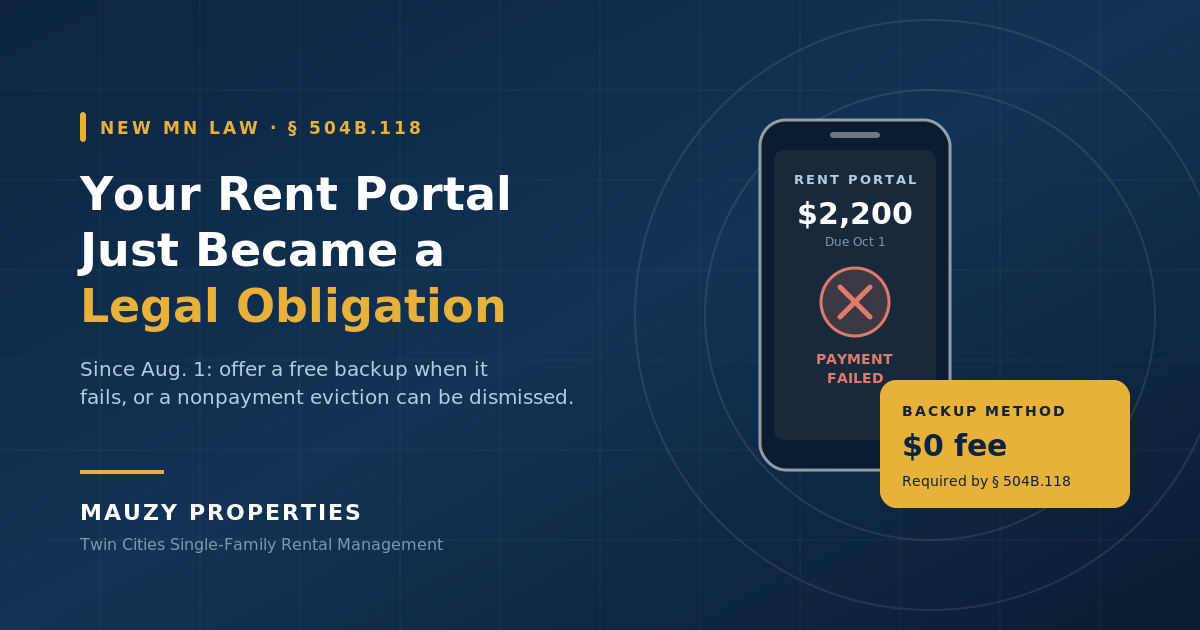
- Digital platforms (subd. 3). If you let tenants pay through a platform (the statute says "requires or permits"), you must offer an alternative when the platform isn't working, and "no fee may be charged to the tenant to use an alternative form of payment." If you know the platform is down, you must restore it or offer the alternative "as soon as practicable." If both the platform and your alternative fail for the tenant, you can't take "any adverse action." The statute names filing an eviction and charging late fees as examples.
- Affirmative defense (subd. 4). If you violate the section, the tenant has a defense to a nonpayment eviction. When the tenant shows a violation, the case "must be dismissed," and the tenant "is entitled to reasonable attorney fees and any other equitable relief the court deems appropriate." This applies to eviction actions filed on or after August 1, 2026.
Why the affirmative defense matters
Look at what triggers the defense. It isn't limited to the portal rule. It applies if "the landlord violates this section," and the section now includes the old cash-receipt rule. Our reading is that an owner who took $2,200 in cash in September and never wrote a receipt has handed the tenant a defense to an October nonpayment case. No court has ruled on this, but a tenant's attorney will read the text the same way.
Here's what a dismissal does to your timeline. Before filing for nonpayment, § 504B.321, subd. 1a requires a written notice with specific statements and a 14-day wait. Minneapolis currently requires 30 days, and St. Paul requires 60 through December 31, 2026. After you file, the hearing is 7 to 14 days after the summons issues. If the case is dismissed, you start over: a new notice, a new wait, a new filing, a new hearing. At $2,200 a month, rent runs about $72 a day. Under the state's 14-day rule, that's three to four more weeks, or roughly $1,500 to $2,000 in rent you're still not collecting. In St. Paul, it's more than two months. Add a second filing fee and the tenant's attorney fees, which the statute makes mandatory when the defense succeeds.
The real risk isn't a crashed portal. It's a small paperwork mistake sinking a legitimate eviction.
The fee question, stated carefully
You'll see summaries saying the new law bans fees for paying rent online. Even the Minnesota House Research Department's official act summary describes the section as preventing "fees charged to the tenant to use the digital platform."
The enacted text is narrower. Subdivision 3(a) says no fee may be charged to use the alternative form of payment. It doesn't expressly ban a fee for using the platform itself. We'd still be careful about reading that as permission, for two reasons.
First, § 504B.120 already governs mandatory fees. For leases signed since January 1, 2024, every "nonoptional" fee has to be disclosed in the lease, and rent plus those fees has to appear on page one as the "Total Monthly Payment." A violation makes the landlord liable for treble damages, and the court may add attorney fees. If your only accepted payment method carries a processing fee, that fee is arguably nonoptional. Take a $3.50 fee charged monthly for a year: $42, trebled to $126. That number is small. A fee award wouldn't be.
Second, Minnesota's junk-fee law, § 325D.44, subd. 1a, took effect January 1, 2025. It requires advertised prices to include all mandatory fees. A private plaintiff gets an injunction rather than damages, but the Attorney General can seek civil penalties. Either way, a mandatory portal fee is a bad idea.
A truly optional fee is different: say, a 2.95% card fee ($64.90 on $2,200 rent) when free ACH is available. The statute doesn't clearly prohibit that. What you can't do is make a fee the price of paying at all, or charge anything for the backup method.
Late fees: the ceiling and the new floor
Two rules now bracket late fees in Minnesota:
- The ceiling (§ 504B.177). A late fee is allowed only if the lease says in writing when it applies, and it can't exceed 8% of the overdue payment (subsidized tenancies have their own rules). On $2,200 rent, the maximum is $176. A late fee isn't treated as interest or liquidated damages.
- The floor (§ 504B.118, subd. 3(c)). If rent is late because both your platform and your alternative failed for the tenant, the late fee is $0, and so is any other adverse action.
If your software charges late fees automatically, you now need a way to reverse them after an outage, which means someone has to notice the outage.
The rest of Chapter 81, briefly
Three more changes took effect on August 1:
- No children as eviction defendants (§ 504B.2136). You can't list a tenant's minor child as a defendant. The penalty is actual damages or $300, whichever is greater, and a lease can't waive it. The exception is a minor who is the only person renting the unit. If you file on a household, name only the adults on the lease.
- Assault is now grounds for expedited eviction (§ 504B.321, subd. 2). If a tenant assaults you, your employees, or your contractors, you can seek the expedited 5-to-7-day hearing. The maximum penalty for misusing the expedited process rose from $500 to $750, so use it only when you have specific facts in an affidavit.
- Estimated final utility bills (§ 504B.216, subd. 7a; § 216B.023, subd. 3a). For duplex and shared-meter owners: if the utility hasn't billed by move-out, you can issue a day-prorated estimate based on the prior billing period, with no extras beyond the statutory administrative and late charges.
The honest caveats
- No case law yet. The law is two months old. Nobody knows how courts will define "not functioning," "as soon as practicable," or whether one missing cash receipt from months ago is enough for dismissal. We've given you our reading, not a ruling.
- Zelle and Venmo are a gray area. The definition covers systems "under the direct control of the landlord or operated by a vendor under contract with the landlord." A peer-to-peer app linked to your personal account may or may not qualify. If you accept rent that way, assume it does and offer an alternative.
- The House Research summary and the statute don't match on fees. We're following the enacted text. A tenant's lawyer may point to the summary. The statute controls, but the mismatch invites argument.
- City notice periods change. St. Paul's 60-day period is temporary and scheduled to drop back to 30 days after 2026. Check the current rule before you serve anything.
What we'd tell you if you called
- Put the backup method in writing now. Add it to the lease or a rent-payment addendum: something free and dull, like a check or money order mailed or dropped at a named address, at no charge if the portal is down.
- Tell tenants before the 1st. A short email or text with the backup method and a number to call costs nothing and is evidence that you offered an alternative.
- Keep an outage log. Take a screenshot of the platform's status page on rent day. If a tenant says the portal didn't work, record the date, time, and what you offered.
- Waive outage-related late fees automatically. Don't wait for the tenant to complain.
- Write cash receipts every time, within three business days. Until a court says otherwise, this is now part of your eviction case.
- Check page one of your lease. Every nonoptional fee should be listed, and rent plus those fees should be totaled as the "Total Monthly Payment."
- Name adults only in an eviction complaint.
Want someone else to watch the portal?
This is part of what we do for the owners we manage every month: collecting rent, monitoring payments, sending the required notices, and keeping the paperwork clean enough that a legitimate eviction doesn't get dismissed on a technicality. See how we handle rent collection, or read the owner FAQ. Management is a flat $100/month.
New to this? Start with our first-time landlord guide, and with heating season starting Thursday, last week's heat-law post.
Questions about your rental? Contact us or call 612.367.7848.
Mauzy Properties · 19950 Dodd Blvd., Suite 102, Lakeville, MN 55044 · info@mauzyproperties.com
Sources: 2026 Minn. Laws ch. 81 (S.F. 4171), §§ 1–5, effective August 1, 2026 (revisor.mn.gov; quoted 2026 language is from the session law); Minn. Stat. §§ 504B.120, 504B.177, 504B.216, 504B.321, subd. 1a, and 325D.44, subd. 1a; City of Minneapolis and City of St. Paul pre-eviction notice pages; Minnesota House Research Department, Act Summary, 2026 Chapter 81 (May 21, 2026); Minneapolis Area REALTORS®, Monthly Indicators, August 2026 (NorthstarMLS data); Freddie Mac Primary Mortgage Market Survey, September 24, 2026. Rent, fee, and timeline examples are illustrations, not market statistics.
This article is general information about Minnesota law, not legal advice. Chapter 81 is new and hasn't been interpreted by an appellate court. Before you change a lease, charge a fee, or file an eviction, talk to a Minnesota landlord-tenant attorney.