

Sometime between November 10 and November 24, an envelope from your county will show up with a "Notice of Proposed Property Taxes" inside. Most owners glance at the bottom line and toss it. This year, in parts of the metro, that bottom line deserves a second look.
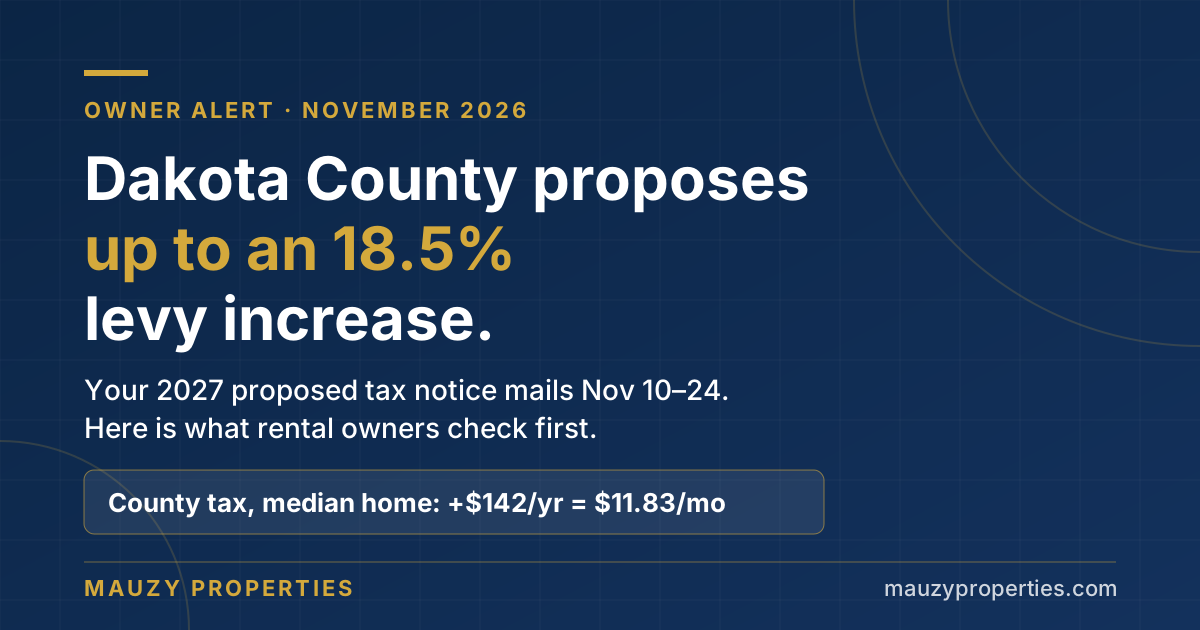
Dakota County's board voted 5-2 on September 22 to set a maximum 2027 levy increase of 18.5%. That is the headline. For a median-value home ($392,100), the increase on the county portion of the bill works out to about $142 a year, because the county is only one slice of the total. Ramsey County is proposing 8.25%. St. Paul is proposing 6.8%.
If you own a single-family rental in Lakeville, Burnsville, Apple Valley, or St. Paul, this notice is the first real look at what 2027 costs you. And unlike most surprises in rental ownership, this one has a calendar attached. You have a few weeks to act on it.
What the numbers actually say
Start with the market because it shapes what you can do about costs. The Minnesota REALTORS September report for the 16-county Twin Cities metro put the median sales price at $395,000, up 1.3% from $390,000 a year earlier. Prices are not falling. But the market is cooler under the surface: days on market rose to 48 from 44 (up 9.1%), inventory climbed 11.2% to 12,411 homes, and pending sales dropped 11.7%, to 3,541 from 4,009.
Mortgage rates are not helping. Freddie Mac's 30-year average was 7.24% on October 29, down from 7.32% the prior week but well above 6.17% a year ago.
Now the levy. According to CBS Minnesota (September 23), 18.5% is the most Dakota County homeowners could see, not a final number. The county cites rising operating costs and federal changes to Medicaid and SNAP. CBS reports a public meeting on December 1 and a final vote on December 15.
Hold on to that last point. A levy percentage is not a tax-bill percentage. Your bill is the sum of the county, your city, your school district, and special districts, applied to your parcel's taxable value. A big jump in one slice moves the total by much less, and the $142 above is the county slice only.
The dates that matter
Minnesota's "truth in taxation" statute, Minn. Stat. § 275.065, sets the schedule:
- Notices go out after November 10 and on or before November 24. The county treasurer mails them first-class to the address on the assessment roll (subd. 3(a)). If your mailing address is out of date, you may not see it on time.
- Most taxing authorities hold a public hearing after November 24, starting no earlier than 6:00 p.m. (subd. 3(c)). Dakota County reports a public meeting on December 1; confirm the hearing time on your notice.
- The final levy generally cannot exceed the proposed levy (subd. 6(a)) for counties, cities, and school districts, with exceptions such as certain voter-approved levies and disaster costs. Final numbers can come in lower. That is why the hearing matters: it is the one point where a room full of owners can change a number.
One duty most owners miss: the tenant copy
Here is the part that catches landlords. For class 4 residential property rented for 30 days or more, the owner must either mail or deliver a copy of the proposed-tax notice to each tenant, or post a copy in a conspicuous place on the premises. The deadline is November 27 or within three days of receiving the notice, whichever is later (§ 275.065, subd. 3(h)).
For a single-family house, mailing or handing a copy to the tenant is the clean way to do it, and write down the date you did. If you use a property manager, confirm in writing who is handling this. The notice goes to the mailing address on the county's assessment roll, so make sure that address is current.
Three things to check on the notice
1. Classification. A single-family rental is class 4bb. Under Minn. Stat. § 273.13, class 4bb uses the same rates as class 1a: 1% of market value on the first $500,000 and 1.25% above that (2026 statute text; confirm the 2027 rates with your county). Duplexes and triplexes are class 4b at a flat 1.25%. If your parcel shows the wrong class, such as a house you moved out of still showing homestead, or a house you live in that qualifies but still shows nonhomestead, raise it with your county assessor. Homestead status generally depends on applying and qualifying. Our post on what losing homestead actually costs covers that trade-off.
2. Current versus proposed. The notice lists, for each taxing authority, your actual 2026 tax and the proposed 2027 tax, with the percentage change in total (subd. 3(d)). Look at which line moves the most. Often it is the city or school district, not the county.
3. What the notice leaves out. The notice states that it excludes special assessments and certain later voter-approved levies (subd. 3(e)). A street project assessment will not show up here.
What it costs you in rent terms
Take a hypothetical house renting for $2,400 a month. If your bill rose by $142 a year (the county-portion increase for a median-value Dakota County home), that is $11.83 a month, or 0.49% of rent. That is real, but small.
Now put it next to vacancy. At $2,400 a month, one day empty costs about $78.90 in lost rent. Two vacant days erase a year's county increase.
That changes how to think about the renewal. Say you want to recover cost by adding $25 a month at renewal. That brings in $300 over a year. If the increase pushes a tenant out and the house sits four extra days, you have lost about $316. You lost money chasing $142 of tax.
This is the honest tradeoff. A good tenant paying on time for years is worth far more than the tax delta, and the market numbers above (48 days to sell, pending sales down) tell you the same about renters: the cost of turnover is easy to underestimate.
Honest caveats
- The 18.5% is a maximum levy. The county can lower it before the final vote but generally cannot raise it, aside from the narrow exceptions. Commissioners have said they have few options, so do not count on a cut.
- The $142 is the county-portion increase for a median-value home, and it assumes typical value growth. Your parcel's value change matters as much as the levy percentage.
- Other counties and your city and school district publish their own numbers, and several are higher or lower than Dakota's county slice.
- Class rates quoted here come from the 2026 statute text. Check the 2027 rates with your county assessor.
- Read your lease before planning any pass-through of tax increases. Rent changes are governed by your lease terms and Minnesota landlord-tenant law, so ask an attorney if you are unsure.
What we'd tell you if you called
Open the envelope the day it arrives. Read the classification line and the current-versus-proposed table. Put a copy to your tenant in the mail by the deadline and keep proof. If the proposed number is a shock, go to the hearing or send written comments to the taxing authority before the final vote. Then run the number against your rent, not against your feelings: $142 a year is $11.83 a month, and a single bad vacancy is a bigger line than that.
For 2027 renewals, price for the market you have. Our ROI calculator will show you what a few days of vacancy does to your return compared with a modest increase.
Talk to us
If we manage your house, forward the notice and we will make sure your tenant copy goes out on time. If you are weighing whether to rent your home, call or message us and we will run your numbers, taxes included. See our pricing and owner FAQ for details, or try the ROI calculator.
Sources: Minn. Stat. § 275.065 (revisor.mn.gov); Minn. Stat. § 273.13 (revisor.mn.gov); Minnesota REALTORS Statewide-Local-Metro Tables, September 2026, 16-county Twin Cities metro (mnrealtor.com); Freddie Mac Primary Mortgage Market Survey, October 29, 2026 (freddiemac.com/pmms); CBS Minnesota, "Dakota County eyes 18.5% property tax levy," September 23, 2026; Sun Thisweek, Dakota County 2027 levy coverage, September 2026; West St. Paul Reader, "How Much Are Property Taxes Going up in 2027?" September 23, 2026.
This post is general information, not legal, tax, or insurance advice. Talk to a Minnesota attorney, a CPA, or your insurance agent about your situation.