

The Twin Cities housing market is neither collapsing nor hot. In September, the median sales price was $395,000, up 1.3% from a year ago. Homes took 48 days to sell, up from 44. Active inventory is up 11.2%, and sellers got 97.7% of their original list price, down from 98.4%. Freddie Mac's 30-year rate was 7.32% on October 22, against 6.19% a year earlier.
That mix is why many Minnesota owners are keeping a house as a rental this year instead of selling it. If that is you, here is the part nobody mentions at the listing appointment: the next nine weeks decide how a chunk of your 2026 tax bill shakes out. Rental owners on the cash method generally deduct expenses in the year they pay them. A water heater paid for on December 29 and one paid for on January 3 land in different tax years.
This is a post about three-year-end decisions where small timing and paperwork choices move real dollars.
What the data actually says
The market numbers above are context, not the story. Prices are up modestly. Buyers have more leverage than they did a year ago. None of that changes your 2026 deductions. What changes them is how you handle the repairs and replacements you have already made, or are about to make, before December 31.
Decision 1: The $2,500 line
The IRS tangible property regulations let you deduct, rather than depreciate, small purchases. Under the de minimis safe harbor, an owner without an audited financial statement can expense items costing up to $2,500 per invoice or per item. The IRS says the threshold applies to tax years beginning on or after January 1, 2016, and that you elect it by attaching a statement titled "Section 1.263(a)-1(f) de minimis safe harbor election" to your timely filed return. You also need a consistent accounting policy in place at the start of the year.
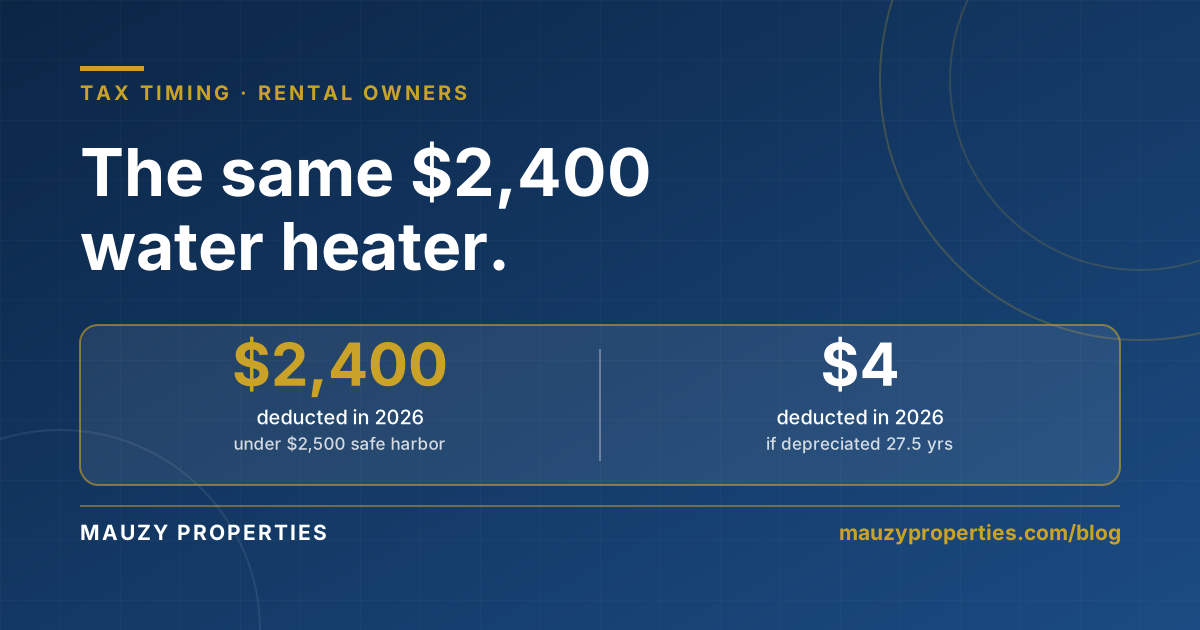
Here is why it matters. Say you replace a water heater for $2,400 and place it in service in December.
- Depreciated as part of the building (27.5 years, mid-month convention): about $4 of deduction for 2026. A full year later is about $87.
- Expensed under the safe harbor: $2,400 this year.
At an assumed combined federal and Minnesota marginal rate of 30%, that is roughly $720 in tax savings against about $1. The rate is an illustration. Plug in your own.
The line is hard. A $2,600 invoice does not qualify, and splitting one job into two invoices to dodge the limit is the kind of thing that does not survive an exam. Ask your contractor to itemize honestly, and ask about it before the work, not in January.
There are two related safe harbors worth a conversation with your CPA. The routine maintenance safe harbor has no dollar cap for recurring work that keeps a property in ordinarily efficient operating condition, but it does not cover betterments. The small taxpayer safe harbor applies to buildings with an unadjusted basis under $1 million and lets you deduct total repair, maintenance, and improvement spending up to the lesser of 2% of that basis or $10,000 for the year. It is an annual election too.
Decision 2: Appliances and the Minnesota add-back
Appliances, carpet, and furniture used in a residential rental are 5-year property under IRS Publication 527, not 27.5 years. Federal law now gives a permanent 100% additional first-year depreciation deduction for eligible property acquired after January 19, 2025, and placed in service (IRS Notice 2026-11).
Minnesota does not follow it. The Department of Revenue says individuals add back 80% of allowable bonus depreciation on Schedule M1MB, then subtract 20% of that addition in each of the following five years.
Example: you buy a $2,300 refrigerator and a $2,100 range, $4,400 in total.
- Federal: With the safe harbor or 100% bonus depreciation, the full $4,400 can be deducted in 2026.
- Minnesota: If you rely on bonus depreciation, you add back $3,520 and recover $704 a year for five years. If you expense the items under the safe harbor instead, our understanding is that they are ordinary deductions rather than bonus depreciation, so there is nothing to add back. Have your CPA confirm that for your return, because the Department of Revenue's bonus depreciation page does not address it.
Which route is right depends on your whole return. This is exactly the kind of question to put to a CPA before December, not in March.
Decision 3: The 1099 line moved
For payments made after 2025, the IRS lists the Form 1099-NEC filing threshold at $2,000. It was $600. If you self-manage and paid a handyman, plumber, or lawn crew $2,000 or more in 2026, you likely owe them a 1099-NEC by January 31 (February 1 in 2027, since the 31st is a Sunday), and you need their W-9 in hand. Collect it now. A contractor who has stopped returning your texts is not going to send a W-9 on January 28.
Honest caveats
- Everything here assumes your rental is a rental. A house you move back into, or personal-use days at a rental, changes the picture.
- Depreciation is not free money. You claim it on the way in and it comes back as depreciation recapture when you sell. That is a reason to track it, not to skip it.
- "Repair" versus "improvement" is a facts-and-circumstances call. A new roof is not a repair because the invoice says repair.
- Tax law changes. Minnesota's treatment of bonus depreciation in particular has moved around, so confirm the current-year Schedule M1MB instructions.
- Our $720 example uses an assumed rate and a single item. Your numbers will differ.
What we'd tell you if you called
If you have repairs sitting unpaid, pay them by December 31 if you want them in 2026. If a single item is near $2,500, ask the vendor for the itemized invoice now. If you bought appliances this year, ask your CPA whether the safe harbor or bonus depreciation is the better route for Minnesota. If you paid anyone $2,000 or more, get the W-9. And if you are still deciding whether to hold or sell, run the numbers on our free Rent vs Sell calculator first.
Talk to us
If we manage your house, send your questions about this year's invoices and we'll point you to the records. Our owner statements are built for exactly this. If you are weighing whether to rent, call, or message us, we'll look at your numbers. See our pricing and guarantees for details.
Sources: Minneapolis Area REALTORS, Monthly Indicators, September 2026 (maar.stats.10kresearch.com); Freddie Mac, Primary Mortgage Market Survey, week ending Oct. 22, 2026 (freddiemac.com/pmms); IRS, Notice 2015-82, IRB 2015-50 (irs.gov/node/51771); IRS, Notice 2026-11 (irs.gov/pub/irs-drop/n-26-11.pdf); IRS, Instructions for Forms 1099-MISC and 1099-NEC (irs.gov/instructions/i1099mec); IRS, Tangible Property Final Regulations (irs.gov); IRS Publication 527, Residential Rental Property (irs.gov/publications/p527); IRS, Notice 2026-11 announcement on additional first-year depreciation (irs.gov); IRS, About Form 1099-NEC (irs.gov/forms-pubs/about-form-1099-nec); Minnesota Department of Revenue, Bonus Depreciation (revenue.state.mn.us/bonus-depreciation). Calculations are illustrative and use the stated assumptions.
This post is general information, not legal, tax, or insurance advice. Talk to a Minnesota attorney, a CPA, or your insurance agent about your situation.