

Mauzy Properties · Twin Cities single-family rental management
On October 1, Freddie Mac's 30-year fixed rate came in at 7.28%. That's up a quarter point in one week and the highest reading since November 2023. Second-half property taxes are due October 15.
Put those two things together, and you get the call we're taking more and more often this fall. Someone listed in the spring didn't get their number and instead rented the house. Now they're looking at a tax statement and asking: How much is this going to go up now that it isn't my homestead?
Most people expect a big number. In Minnesota, for a typical single-family house, the number is small. The expensive mistakes are around it: not reporting the change, losing a refund you didn't know you were getting, and missing an exception that would have let you keep homestead.
What the market is doing
Nobody publishes a count of owners who rent rather than sell, so here's the data behind our read. Prices aren't falling. Minneapolis Area REALTORS® put the August median sale price at $404,000 in its September 28 weekly report, up 1.0% from a year earlier. The market is slowing, though. For the week ending September 19, pending sales were down 17.2% from the same week last year, while new listings rose 15.0% and inventory rose 9.6% to 12,237 homes. Months of supply reached 3.1, up from 2.8. Then rates jumped again.
When buyers pull back, and prices hold, sellers who need a particular number tend to rent instead. That's often the right move. It also changes how the county classifies your house.
The class rate doesn't change. The exclusion does.
Owner-occupied and rented houses were taxed at very different class rates. They aren't anymore. The Department of Revenue's assessor manual says current residential class rates "have eliminated the difference between homesteads and non-homesteads."
For taxes payable in 2026:
- Class 1a (residential homestead): 1.00% on the first $500,000 of value, 1.25% above that.
- Class 4bb (single-unit residential non-homestead): the same rates, 1.00% and 1.25%.
- Neither class pays the state general tax, and both pay voter-approved referendum levies on market value.
So a rented single-family house with one unit is taxed at the same class rate as when you lived in it. (Two- and three-unit buildings that aren't owner-occupied are class 4b at a flat 1.25%. That's a different conversation.)
What you do lose is the homestead market value exclusion under Minn. Stat. § 273.13, subd. 35. It knocks part of your home's value off before the class rate is applied:
- For amounts of $95,000 or less, 40% of the value is excluded.
- Above $95,000, the maximum $38,000 exclusion shrinks by 9 cents for every dollar of value over $95,000.
- At $517,200 and above, the exclusion is zero.
That phase-out matters here. A large share of the Twin Cities houses that turn into rentals are worth close to the median, which is right where the exclusion has mostly run out.
The actual numbers
The dollar cost is the lost exclusion × 1% class rate × your local tax capacity rate. We ran it with two real 2026 rates: Lakeville in ISD 194 (84.642%, from Dakota County's final pay-2026 rates) and Minneapolis (about 138% to 140% depending on watershed district, from Hennepin County's proposed pay-2026 rate card; final rates may differ slightly).
| Home value | Exclusion lost | Lakeville (ISD 194) | Minneapolis |
|---|---|---|---|
| $250,000 | $24,050 | about $204/yr | about $332/yr |
| $325,000 | $17,300 | about $146/yr | about $239/yr |
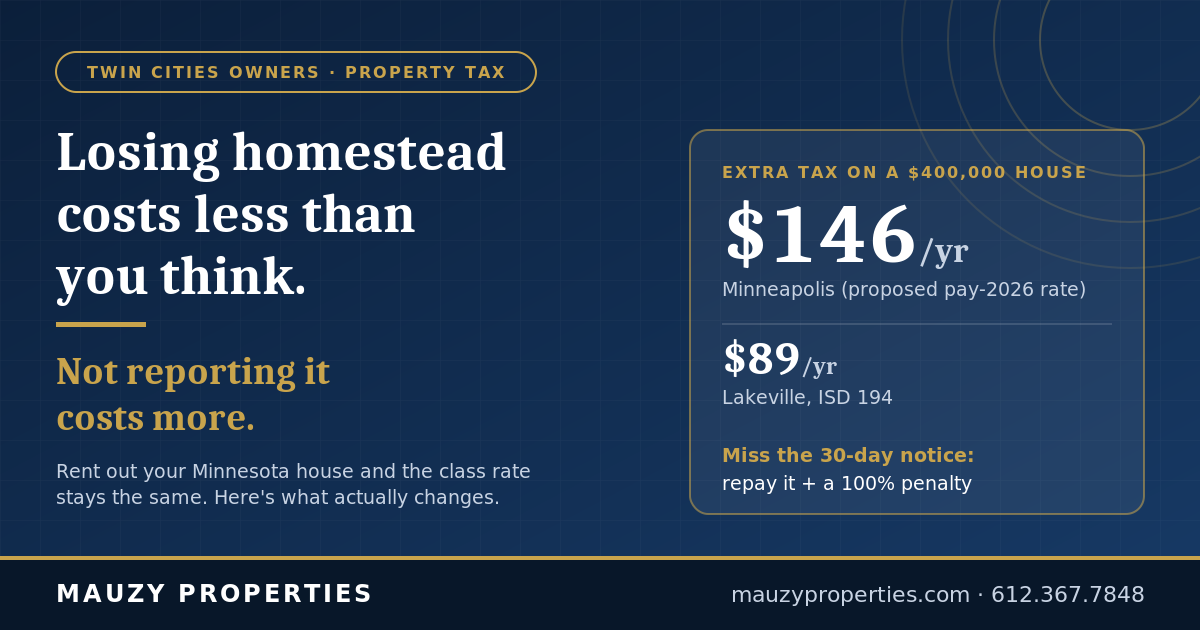
| $400,000 | $10,550 | about $89/yr | about $146/yr |
| $450,000 | $6,050 | about $51/yr | about $84/yr |
| $520,000+ | $0 | $0 | $0 |
On a $400,000 house in Lakeville, the homestead exclusion is worth less than $90 a year, or about $7.50 a month. That cost by itself shouldn't decide whether you sell or rent.
These figures hold everything else constant. Your new assessed value and next year's levies will usually move your bill more than the classification change. Your rate depends on your city, school district, and watershed, and your tax statement lists it.
When the change shows up
Minnesota assesses property as of January 2 each year (Minn. Stat. § 273.01). The DOR manual describes a homestead as "a fact situation as of a particular date." When an owner reports a move, the manual tells assessors to "remove the homestead as of the next assessment date."
So if you lived in the house on January 2, 2026, moved out this summer, and reported it on time, it generally retains its homestead classification for the 2026 assessment, which taxes are payable in 2027. It becomes non-homestead on the January 2, 2027, assessment, which is taxes payable in 2028. That's only if you reported it. Miss the 30-day notice, and the statute says the property "will lose its current homestead status," with a penalty on top.
That means the proposed tax notice arriving in late November probably still says "homestead." It doesn't mean the county missed anything. It also doesn't let you skip the paperwork.
One more November item: once the house is classified as a rental, § 275.065, subd. 3 requires you to give your tenant a copy of that proposed tax notice, or post it in a conspicuous place, by November 27 or within three days of receiving it, whichever is later.
The part that costs real money: not telling the county
Minn. Stat. § 273.124, subd. 13 requires you to notify the county assessor within 30 days when you stop occupying the property as your homestead. Failing to do so "shall result in the penalty provided" and the loss of homestead status. The DOR manual spells out the consequence: you repay the difference between the homestead and non-homestead tax, plus a penalty equal to 100% of the homestead benefits (§ 273.124, subd. 13b). Interest can be added, and unpaid amounts can go onto the property's tax statement.
Doubling a small number still gives you a small number. On that $400,000 Minneapolis house, two unreported years work out to roughly $290 in benefits plus $290 in penalty. You'd be paying that to fix a form you could have filed online in five minutes. Dakota County has an online "Request for Non-Homestead Classification," Hennepin has a "Notice of Move," and other counties have their own versions.
The refund you might be losing
For many middle-income owners, this matters more than the exclusion. The Homestead Credit Refund (Form M1PR) is only for homeowners who owned and occupied the home on January 2. For the 2025 refund, which is based on taxes payable in 2026:
- Household income must be under $142,490.
- The refund comes from a sliding table by income and tax. For middle-income households, it's commonly several hundred to over a thousand dollars.
- The 2026 Legislature added a one-time 14.88% increase for this year's refund.
- The special refund (up to $1,000, no income limit) also requires occupancy on January 2 of both years.
The timing works in your favor once. If you lived in the house on January 2, 2026, you can still claim the 2025 refund even though you've moved out. The regular due date was August 17, 2026, but late claims are accepted until August 16, 2027. You won't qualify for the next refund, which is based on taxes payable in 2027, because you weren't living there on January 2, 2027. That's a year before the classification change shows up on your bill.
Three exceptions worth checking
1. Relative homestead. If the person living in the house is your (or your spouse's) parent, stepparent, child, stepchild, grandparent, grandchild, sibling, uncle, aunt, nephew, or niece, the house can keep homestead treatment under § 273.124, subd. 1(c). The statute doesn't say rent disqualifies it, but ask your assessor before you rely on that. You have to file a homestead application, and the relative has to sign it. The trade-off is that neither of you can claim the M1PR refund on that property. The application deadline is December 31 for taxes payable next year.
2. Duplexes and triplexes. If you live in one unit of a duplex or triplex, the whole building is a class 1a homestead. Move out of the owner's unit, and the building drops to class 4b at 1.25%, which costs a lot more than losing the exclusion on a single-family house.
3. Temporary absence. You can be away for a while and keep homestead if the house is "maintained as a homestead awaiting the owner's return." A tenant in the house doesn't count. In most cases, the DOR manual says, renting it out ends the homestead.
The honest caveats
- Thresholds can change. Bills to raise the exclusion thresholds were introduced in 2025–2026. As of the statute's last amendment (2023), the $95,000 and $517,200 figures still apply.
- Counties handle mid-year changes slightly differently. The January 2 date is in statute. How a mid-year move is handled comes from DOR guidance, and your assessor makes the call on your parcel.
- This isn't the big tax issue. The bigger tax question when you rent a former residence is the Section 121 clock on the capital-gains exclusion, which we covered in 7 Things Minnesota Homeowners Get Wrong When They Rent Out Their House. Losing a homestead is small by comparison.
What we'd tell you if you called
- File the non-homestead notice now if you moved out and haven't filed. It's free and fast, and it stops the penalty from growing.
- File your 2025 M1PR if you lived there on January 2, 2026, and qualify by income. Don't leave it unclaimed.
- Ask whether a relative homestead applies before December 31 if the family is in the house.
- Use your real tax rate, not a scary rule of thumb. Your statement shows it.
- Put the actual dollar figure into your sell-or-rent decision. Our Rent vs. Sell calculator is a good place to start.
- Talk to a CPA about Section 121 and depreciation before you sign a second lease.
Want the paperwork handled?
We manage single-family rentals across Minneapolis, St. Paul and the south metro for a flat $100/month. That includes screening, rent collection, in-house maintenance, and owner statements that your CPA can actually use. New to this? Start with our owner FAQ and first-time landlord guide. Still deciding? Read Sell Now, Rent It, or Wait for Spring?
Questions about your rental? Contact us or call 612.367.7848.
Mauzy Properties · 19950 Dodd Blvd., Suite 102, Lakeville, MN 55044 · info@mauzyproperties.com
Sources: Minn. Stat. §§ 273.01; 273.13, subds. 22, 25 and 35; 273.124, subds. 1, 9, 13 and 13b; 275.065, subd. 3 (revisor.mn.gov); Minnesota Department of Revenue, Classification Rates for Taxes Payable in 2026, and Property Tax Administrator's Manual, Module 3 (Classification) and Module 4 (Homesteads, updated July 2026); Minnesota Department of Revenue, 2025 Form M1PR Instructions; Dakota County, Final Tax Rates Pay 2026 and Homestead page; Hennepin County, 2025–2026 Proposed Tax Rates card; Minneapolis Area REALTORS®, Weekly Market Activity Report for the week ending September 19, 2026 (NorthstarMLS data); Freddie Mac Primary Mortgage Market Survey, October 1, 2026. Dollar figures are illustrations calculated from the statutory formula and published 2026 tax rates, not a quote for any parcel.
This article is general information, not tax or legal advice. Property tax classification depends on facts your county assessor determines, and the income-tax side of renting a former home is complicated. Before you change how a property is used or claimed, talk to a CPA or a Minnesota tax attorney and confirm the details with your county assessor.