

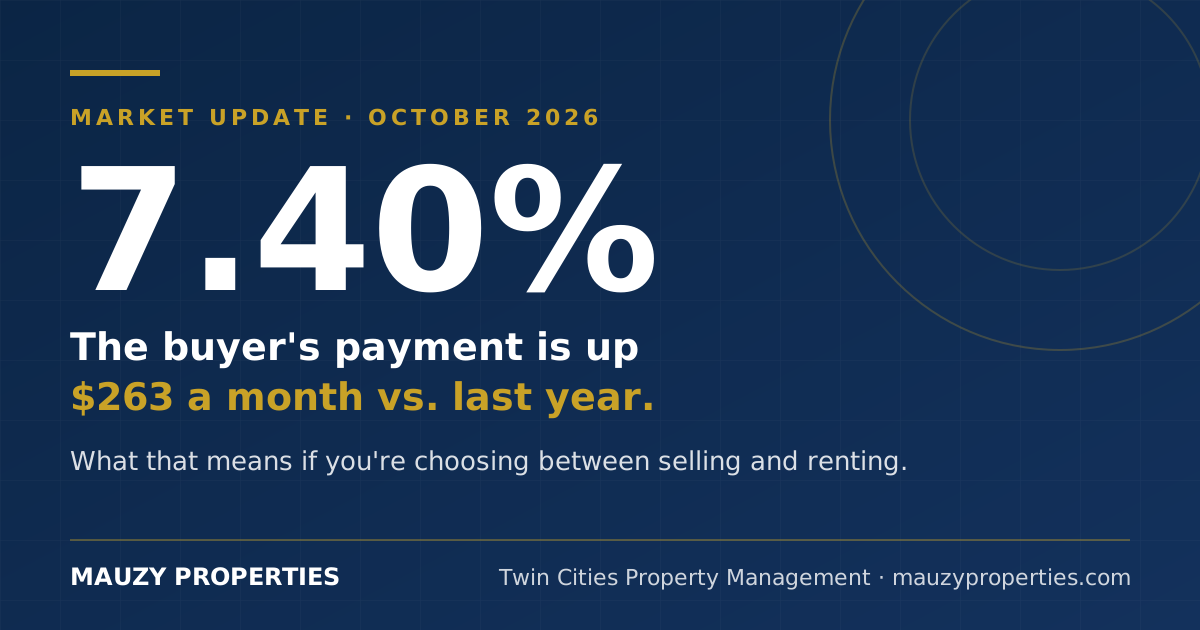
On Thursday, Freddie Mac reported the average 30-year fixed rate at 7.40%. A week earlier, it was 7.28%. A year ago, it was 6.30%. That is 110 basis points in twelve months, and it happened while the Twin Cities median sale price barely moved.
If you own a house in Lakeville, Plymouth, Eagan, or anywhere else in the metro and you're deciding between selling and renting, the rate is not background noise. It sets the monthly payment of the person you're hoping will buy your house. Here is what it does to that payment, and what we would do about it.
What the data actually says
The latest Minneapolis Area REALTORS® monthly indicators cover August 2026 for the Twin Cities region (MAAR's NorthstarMLS definition, which differs slightly from the 7-county figures other groups publish):
- Median sales price: $405,000, up 1.3% from $400,000 a year ago.
- Days on market until sale: 45, up from 42.
- New listings: 6,481, up 8.2%.
- Closed sales: 4,627, down 1.4%.
- Inventory: 11,698 homes for sale, up 7.9%.
- Months of supply: 3.0, up from 2.8.
- Percent of original list price received: 98.2%, down from 98.8%.
Read that straight. Prices are not falling. They are up, slightly. But every other line leans toward the buyer: more listings, more inventory, slower sales, and sellers conceding a bit more off the original ask. Three months of supply is not a glut, so this is not a collapse. It is a market where sellers have a little less leverage than they did a year ago.
Now add the rate.
The buyer's payment, with the math
Take the median price of $405,000 and assume a 20% down payment, which is the assumption behind the Freddie Mac survey. That is an $81,000 down payment and a $324,000 loan. Principal and interest on a 30-year fixed:
- At 7.40%: about $2,243 a month.
- At 6.30% (last year's rate), same house: about $2,005 a month.
- Last year's actual median ($400,000) at last year's rate: about $1,981 a month.
So the buyer of a median-priced home is paying roughly $263 more per month than the buyer a year ago, about $3,150 a year, or 13% more. Almost all of that is the rate, not the price.
Flip it around. A buyer who was comfortable with a $1,981 principal-and-interest payment last October can borrow about $286,000 at 7.40% instead of $320,000. At 20% down, that is a purchase budget of roughly $358,000 instead of $400,000. Same paycheck, about $42,000 to $47,000 less house, depending on which year's median you compare against.
These figures are principal and interest only. Property taxes, homeowner's insurance, and mortgage insurance on anything under 20% down push the real payment higher. We calculated these in code rather than by hand, and you can rerun them with your own numbers.
What that means if you're thinking about selling
Your buyer pool didn't disappear. It got smaller at the price you want. Some buyers will stretch. Some will drop out. Some will shop the lower end of your market, which pulls demand away from the middle.
Our read, and it is a read, not a forecast: if you list a house at or near the median and you need to net a specific number, plan for a longer sale and a bigger negotiation than the median days-on-market suggests. The 45-day figure is an average across every price point and condition. A house that is overpriced or dated sits well past it.
If you have to sell, because of a job move, a divorce, an estate, or a balance sheet that needs the cash, then price it to the market as it is today and don't wait for rates to fix it. Nobody knows where rates go next. Waiting is a bet, and it should be a bet you chose, not one you drifted into.
What that means if you're thinking about renting
Here is the part most owners miss. The 7.40% rate hurts you twice when you sell and replace: once as a seller, because the buyer can pay less, and again as a buyer, because whatever you buy next carries today's rate.
Consider a hypothetical. You owe $250,000 at 3.25% on a 30-year loan. Your principal and interest is about $1,088 a month. If you sell and buy another house with a $324,000 loan at 7.40%, you are at about $2,243. That is more than double. A low-rate mortgage is an asset, and selling the house throws it away.
That does not mean renting wins every time. It means the question has changed. The old question was "Can I get my price?" The better question now is "What is my low-rate loan worth to me?" If you can cover the mortgage, taxes, insurance, maintenance, and a vacancy reserve with rent, holding the house keeps a cheap loan paid down by someone else.
We're not telling you rents will jump because of this. We don't have a primary-source rent series that says so, and we won't invent one. The logical pressure is that a more expensive purchase pushes some would-be buyers to keep renting longer, which supports tenant demand. That is an inference. Treat it like one.
Run your own numbers before you decide
Three numbers decide this, and you already have two of them:
- Your mortgage payment, taxes, and insurance. Total monthly carrying cost.
- Realistic market rent. Not the Zillow estimate. What comparable houses actually leased for in the last 60 days.
- What you'd net if you sold today. Price, less commissions and closing costs, less payoff.
Then subtract maintenance (budget 1% of the home's value a year as a starting point), a vacancy allowance, and property management. Our flat fee is $100 a month for single-family homes, and it includes basic handyman service. If the house cash-flows with those costs in, and you don't need the equity, holding is worth a serious look. If it only works when nothing breaks and the tenant never leaves, it doesn't.
Our Rent vs. Sell calculator and ROI calculator will do the arithmetic. The numbers are yours to enter.
The honest caveats
- Rates move. Freddie Mac publishes the survey every Thursday. The rate that was 7.40% this week could be 7.0% or 7.8% by Thanksgiving. Nothing in this post is a rate forecast.
- The median hides the spread. A Lakeville townhome, a Minneapolis bungalow, and a Plymouth five-bedroom are not one market.
- Renting has costs and risks. Vacancy, turnover, repairs, and a tenant who stops paying are real. Minnesota's landlord-tenant statutes (Chapter 504B) have specific notice, deposit, and eviction rules. Read our posts on homestead classification and the rent-collection rule changes before you sign a lease.
- Taxes matter. Selling and renting can produce very different tax outcomes, including how the home sale exclusion works if you rent the house for several years. That is a CPA question, not a blog question.
What we'd tell you if you called
- If you have to sell for life reasons, sell. Price it for today's buyer, not last spring's.
- If you don't have to sell and you hold a mortgage well below today's rate, run the hold-and-rent numbers first. You are giving up something valuable by selling.
- If the house only cash-flows on paper, don't rent it just because you can't sell. Compare the monthly shortfall to the cost of waiting.
- Get a rent estimate from actual leased comps, not a listing portal.
- Talk to a CPA about the tax side before you pick a direction, not after.
- Decide on a timeline. "Wait for rates to fall" is not a plan. "Rent for 24 months, then reevaluate" is.
Our earlier posts on what to do when a house doesn't sell and why the 2026 numbers favored holding cover the broader picture. This post is the October update: rates moved, and that changes the buyer's math.
Want a second set of eyes on your numbers?
We manage single-family rentals across the Twin Cities, with a local team and an in-house handyman crew, for a flat $100 a month. If you want to know whether your house works as a rental, send us the address and your rough numbers and we'll tell you what we see, including when the answer is "sell it."
Questions about your rental? Contact us or call 612.367.7848.
Sources: Freddie Mac Primary Mortgage Market Survey, October 8, 2026 (30-year fixed 7.40%; 7.28% prior week; 6.30% year ago); Minneapolis Area REALTORS® Monthly Indicators, August 2026, Twin Cities region. Payment figures are principal and interest only, calculated for a 30-year fixed loan with 20% down and are illustrations, not a loan quote. The 3.25% mortgage example is hypothetical.
This article is general information, not tax, legal, insurance, or financial advice. Tax treatment of selling versus renting a home, and Minnesota landlord-tenant requirements, depend on your facts. Consult a CPA, a Minnesota real estate attorney, and your insurance agent before making a decision.