

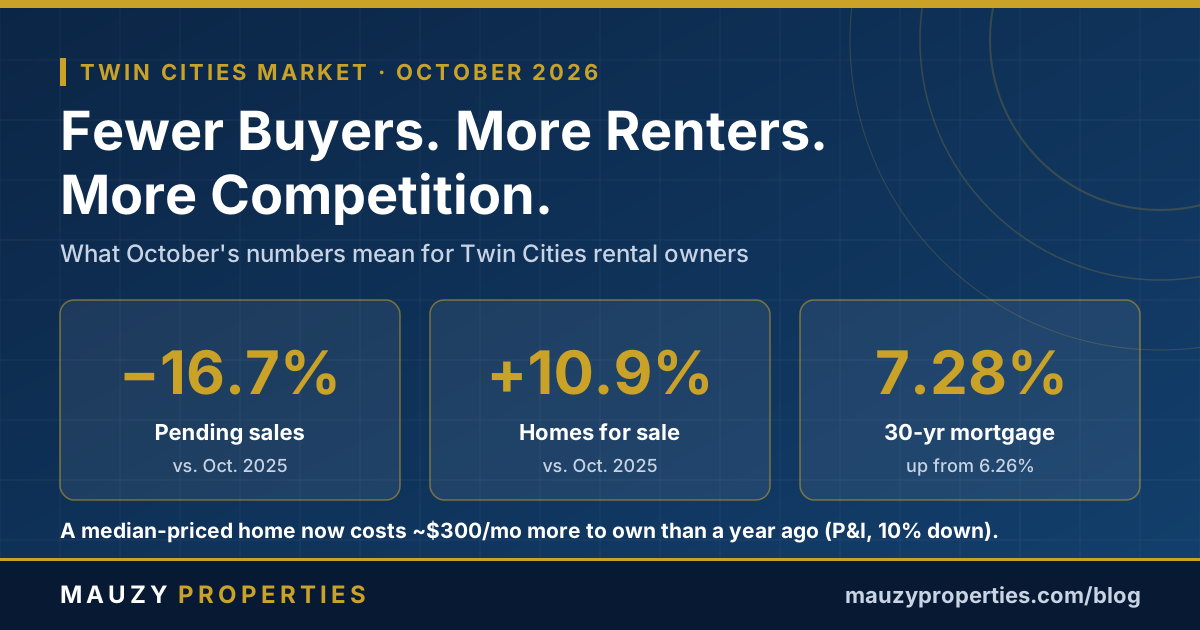
The October market report from Minneapolis Area REALTORS® came out last week, and one number in it should get the attention of anyone who owns a rental house in the Twin Cities: pending sales were down 16.7% from a year ago. Then on Thursday, Freddie Mac's weekly survey put the average 30-year mortgage rate at 7.28%, up from 6.26% at this time last year.
Fewer people are signing purchase agreements, and those who do are paying much more to borrow. Some of the people who would have bought a house this fall are going to rent one instead. That's good news for single-family landlords, mostly. But there's a second effect in the same report that's less fun to talk about, and it's the one I'd plan around.
What the data actually says
Here are the October 2026 numbers for the Twin Cities region, compared with October 2025:
| Measure | October 2026 | Change vs. Oct. 2025 |
|---|---|---|
| Median sales price | $400,000 | +2.6% |
| Pending sales | 3,245 | −16.7% |
| Closed sales | 3,671 | −12.5% |
| New listings | 5,539 | −6.5% |
| Homes for sale (inventory) | 12,137 | +10.9% |
| Months of supply | 3.2 | up from 2.8 |
| Days on market until sale | 51 | up from 48 |
| Percent of original list price received | 97.2% | down from 98.1% |
Read that table carefully, because it's easy to tell the wrong story. The median price is still rising. It's up 2.6% from a year ago. What's changing is the pace. Homes are sitting on the market longer, sellers are giving up a little more of their original asking price, and unsold inventory is building because buyers are signing fewer deals than sellers are listing.
Three months of supply is still not a buyer's market by the usual definitions. But it's moving that direction, and it's moving while rates are going up, not down.
The ownership math: what a $400,000 house costs now
Here's what a year of rate movement did to the monthly payment on a median-priced Twin Cities house, assuming 10% down on a 30-year fixed loan:
| Last November | This November | |
|---|---|---|
| Median price | $390,000 | $400,000 |
| Loan (90%) | $351,000 | $360,000 |
| 30-year rate (Freddie Mac PMMS) | 6.26% | 7.28% |
| Principal & interest | $2,163/mo | $2,463/mo |
That's about $300 more per month, or roughly $3,600 a year, for the same kind of house, just from a one-point rate increase and a modest price bump. About $244 of that $300 is the rate alone.
Add property taxes and insurance (I'm using 1.1% of value for taxes and $200 a month for insurance as round illustrative figures; your county and carrier will differ), and the all-in housing cost on that median house is roughly $3,030 a month, before mortgage insurance, HOA dues, or a single repair. At the traditional 28% housing-to-income guideline, a buyer needs about $130,000 of household income to carry that, up from about $117,000 a year ago.
Many households in the $100,000–$130,000 range who could have stretched to buy a house last year won't qualify for the same house this year. They didn't stop needing three bedrooms and a yard. They're renting one.
Why this mostly helps single-family rental owners
Your current tenants are less likely to leave to buy. "We bought a house" is one of the most common reasons a good tenant gives notice. When the payment on the house they'd buy jumps by $300 a month, more of them renew. That matters more than almost anything else for your annual return. A vacancy plus a turnover costs most owners more than a modest rent increase earns, which is the renewal math we walked through two weeks ago.
The renter pool for houses gets better. The people pushed out of buying are often exactly the tenants you want: steady income, decent credit, saving for a down payment, careful with a house because they hope to own one like it someday. They want a single-family home, not an apartment.
It strengthens your hand at renewal, within reason. When the alternative to renewing is a $3,000-plus ownership cost or an expensive move in January, a fair increase is easier to accept.
The part nobody likes: more competition from owners who couldn't sell
Here's the unflattering half. Inventory is up 10.9%. Days on market are up. Sellers are getting 97.2% of their original list price, down from 98.1%. Some of those 12,137 listings won't sell this winter, and a share of those owners will do what a lot of stuck sellers do: pull the listing and rent the house out instead.
That means more single-family homes competing for the same renters, often listed by first-time landlords who price to cover their mortgage rather than to the market, and that sometimes means under it. If your lease ends in the next few months, you may be competing with a freshly painted house down the street listed $150 under yours.
And rents themselves aren't surging. Apartment List puts the Minneapolis city median at $1,454 in its November 2026 report, up 2.4% year over year, and the metro median up 1.9%. An October analysis from the Minneapolis Fed described the city's rents as stable with a recent uptick, with an August median of $1,469, up 3% from a year earlier. That's apartment data, not single-family homes, but the direction matters: steady low-single-digit growth, not a surge. I wouldn't plan on rising rates letting you push your rent up 8% this year.
So the net effect isn't "rents are going up." It's closer to "good tenants are more likely to stay, and vacancies will be more competitive." Those point to the same strategy: keep the tenant you have.
If you're deciding between listing in spring and renting
If you're a homeowner who was planning to sell and is now looking at these numbers, a few honest points:
Don't assume spring fixes it. Spring always brings more buyers, but it also brings more listings. If rates are still in the 7s in April, the October trend in pending sales is more likely to continue than reverse.
Renting buys you time, not a guarantee. If you rent the house for a year or two, you're betting on a better selling environment later. That may happen. It may not. Run your own numbers on our rent vs. sell calculator before you decide either way.
Know the costs of becoming a landlord. Renting out your former home usually means losing the homestead classification on your property taxes, which can raise your tax bill noticeably, and it changes the capital gains picture down the road. We covered the homestead piece in October. Talk to a CPA about the tax side before you sign a lease.
Price it like a rental, not like a mortgage. Your tenant doesn't care about your payment. If the market rent doesn't cover your costs, that's worth knowing before you list, not after it sits empty for six weeks in January.
Honest caveats
- These are regional, all-property-type numbers. A three-bedroom in Lakeville and a condo in downtown Minneapolis are in different markets. Your neighborhood can run hotter or colder than the median.
- Mortgage rates move weekly. They fell four weeks in a row this fall before jumping 17 basis points last week. If they drop meaningfully, the buyer pool comes back fast.
- The payment math above uses illustrative tax and insurance figures and ignores mortgage insurance. A buyer putting 20% down, or buying in a lower-tax city, faces a different number.
- The apartment rent figures are the best current public data, but they aren't a direct measure of single-family rents.
- One month of data is one month. October's slowdown is worth watching, not panicking over.
What we'd tell you if you called
If your tenant is renewing in the next few months, make the renewal easy and price it fairly. Losing a good tenant into a market with more competing listings is the expensive mistake right now, not leaving $50 a month on the table.
If you have a vacancy, price it to rent in December, not to hold out for spring. More houses are coming onto the rental market from owners who couldn't sell, and the ones that rent first are priced right and look ready. Our post on whether to cut rent or hold out has the break-even math.
If you're on the fence between selling and renting, don't make the call off a headline. Look at your actual rent estimate, your actual carrying costs, and what you'd net from a sale today. Then decide.
Want a straight answer on your house?
Mauzy Properties manages single-family rentals across the Twin Cities for a flat $100 a month, and we back every placement with our tenant warranty. If you're weighing a renewal, sitting on a vacancy, or trying to decide whether to rent the house you can't sell, call or message us at 612.367.7848 and we'll look at your numbers with you. You can also see our pricing and our guarantees.
Sources: Minneapolis Area REALTORS® / NorthstarMLS, Monthly Indicators, October 2026 (released November 2026); Freddie Mac Primary Mortgage Market Survey, week of November 19, 2026; Apartment List, Minneapolis Rent Report, November 2026; Federal Reserve Bank of Minneapolis, "Minneapolis 2040 plan indicators point to stable rents, stalled development" (October 7, 2026). Payment calculations are standard 30-year amortization; tax and insurance figures are illustrative assumptions.
This post is general information about the Twin Cities housing market as of November 2026, not legal, tax, financial, or insurance advice. Mortgage, tax, and insurance costs depend on your situation. Before deciding whether to sell or rent a property, talk with a CPA about the tax consequences, a lender about financing, and your insurance agent about landlord coverage.