

On November 3, St. Paul voters approved City Question 1 by nearly 80 percent, according to unofficial results. It creates Chapter 34A of the city code, the Tenant Right to Repair in Residential Rental Property, and it changes the math on every repair request you get from a St. Paul tenant.
The short version: if a tenant gives you proper notice and the repair isn't done within 14 days, they can fix it or hire someone, hand you the receipt, and deduct the cost from the rent.
The timing is not great for owners. It is November in Minnesota. Furnace calls, drafty windows, frozen hose bibs, and icy front steps are about to arrive in volume, and every one of them is on the ordinance's list of eligible repairs.
What the ordinance actually says
We read the full text, not the campaign summary. Here is what matters for an owner.
Notice comes two ways. The tenant must send written notice to the address where they pay rent (or another known mailing address) and also call, text, email, or use the rental portal if available. The notice must identify the repair and state that the tenant intends to deduct the cost.
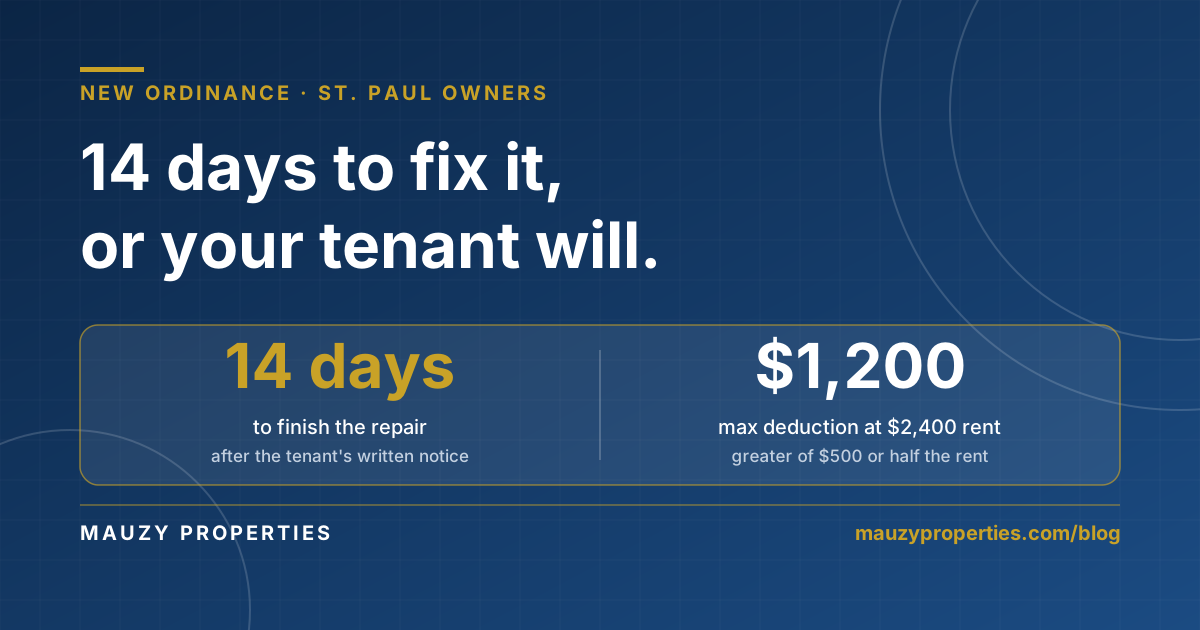
You get 14 days. The clock starts with the written notice. The ordinance describes it as a 14-day "opportunity to complete repairs," and the trigger language is that the landlord "has not completed" the repair in that window. The campaign's own materials say repairs are "scheduled" within 14 days, but the ordinance text says "completed." Until the city says otherwise, plan on finishing, not scheduling.
The cap is the greater of $500 or half a month's rent. Not the lesser. We saw at least one national ballot-tracking site get this backward. For subsidized tenants, the half-month figure is based on fair market rent, not the tenant's share.
The tenant needs a receipt first. They must give you a payment receipt before making the deduction. You can choose to reimburse them directly instead. If the lease ends before they can deduct, you owe the reimbursement.
The work has to be done right. Repairs must be "workmanlike" and, where the law requires a license, done by a licensed person. Anything bought through the deduction, like a new appliance, becomes your property.
What the cap looks like at real St. Paul rents
Because the cap is the greater of two numbers, it scales with rent once rent passes $1,000 a month:
| Monthly rent | Maximum deduction |
|---|---|
| $900 | $500 |
| $1,000 | $500 |
| $1,450 | $725 |
| $1,800 | $900 |
| $2,400 | $1,200 |
| $3,000 | $1,500 |
Above $1,000 a month, the cap is always exactly half a month's rent. On a typical single-family rental, that covers a large share of the routine service calls an owner sees in a year. The ordinance isn't limited to small fixes. It's limited to small invoices, and at Twin Cities single-family rents, the invoice limit isn't that small.
What counts as a repair
The ordinance lists 26 categories and says "including but not limited to." The list covers floors, walls, ceilings, windows, and exterior doors; plumbing, fixtures, and any appliance you supply; electrical and heating systems; smoke and carbon monoxide alarms; roofs, foundations, and porches; pests; garbage facilities; and snow and ice removal from sidewalks, walkways, and driveways.
Two items deserve attention from single-family owners. First, snow and ice are on the list. If your single-family lease shifts snow removal to the tenant, ask your attorney how that clause holds up under the ordinance. Second, energy measures: weatherstripping, caulking, and storm windows qualify when they would lower energy costs. In a 100-year-old St. Paul house, that is a long list.
What's excluded
Tenants can't use the remedy for damage they caused, or that their household or guests caused, through deliberate or negligent acts. The ordinance also doesn't apply to certain owner-occupied units that are exempt from St. Paul's fire certificate of occupancy, or to bed-and-breakfasts, short-term rentals, or hotels. Existing emergency repair rights stay in place.
How to dispute a repair
If you believe a repair isn't required, you must do two things within 14 days of the tenant's notice: send the tenant written notice that you dispute it, and arrange for the city's building official to inspect. If you miss the 14-day window, you waive the right to argue that the repair wasn't needed.
If the inspection confirms the repair, or the inspection doesn't happen within 30 days of your dispute notice, the tenant can go ahead. That 30-day period puts you at the mercy of the city's inspection schedule, so request the inspection the same day you send the dispute.
What you can't do
You can't waive it in the lease. Any waiver is void.
You can't evict for the deduction. A tenant who follows the process can't be evicted for nonpayment because of the amount they deducted.
You can't retaliate. That covers raising rent, cutting services, changing the lease, filing suit, or threatening eviction as a penalty. Any adverse action taken within 90 days of a tenant's use of the ordinance is presumed retaliatory. Minnesota's eviction statute already uses a 90-day window for retaliation defenses (Minn. Stat. § 504B.285), so this is familiar ground, but the St. Paul version covers more actions.
The penalties are real. A tenant can recover a rent reduction, up to and including full rescission of the lease, up to $500 per violation, plus attorney fees and costs. The city can also fine, and a landlord violation is a misdemeanor.
Two details that hit your bottom line
Rent stabilization. Repair deductions normally don't change your rent stabilization math. But if the repair addressed a health or safety threat, the maximum allowable rent for future increases drops by the average of all deductions for that unit over the prior 12 months. A slow response to a safety issue now can cap your rent growth later.
Tax reporting. The ordinance says it doesn't relieve owners of federal information reporting. For payments made in 2026, the IRS 1099 threshold is $2,000 per payee, up from $600. Whether a deducted repair triggers a form depends on who was paid and whether your rental is a trade or business. That's a question for your CPA. Either way, book the deduction as a repair expense, not lost rent. Our post on year-end repair decisions covers how that affects your 2026 return.
Honest caveats
The ordinance's legal footing is not settled. St. Paul's city attorney warned before the vote that parts of it may conflict with state law, and the city council blocked it from the ballot 5-2 in August over concerns that it reaches into building-code authority that belongs to the state. The courts put it back on the ballot without ruling on its validity. A legal challenge is possible.
The city also hasn't published implementation guidance or codified text as of this writing. The details we've cited come from the ordinance text as it appeared on the ballot. The council has also noted that a voter-approved ordinance can't be amended or repealed for one year, so a quick legislative fix isn't available.
None of that changes what an owner should do today. If you treat it as law now and it gets narrowed, you've lost nothing. If you wait for clarity and it holds, you've given a tenant a 14-day head start on your money.
It also isn't new in principle. Minnesota's rent escrow statute (§ 504B.385) already gives a landlord 14 days to correct a violation before a tenant can deposit rent with the court. What changes is the remedy: the tenant no longer needs a judge.
What we'd tell you if you called
Treat every St. Paul repair request as a 14-day clock that starts the day it lands, by mail, text, email, or portal. Log the date. Decide within two days whether you'll fix it or dispute it.
If you'll fix it, finish it. If a part is backordered, tell the tenant in writing what's happening and when it will be done.
If you'll dispute it, send the written notice and request the city inspection that same day. Take photos either way.
Pull your St. Paul leases and remove anything that appears to waive repair rights. Make sure the lease lists every channel a tenant should use for maintenance, so you know where notices will arrive.
Then get ahead of the predictable ones. Test smoke and carbon monoxide alarms, check weatherstripping, and look at the furnace before the first cold snap does. Our post on the 68-degree heat law covers the heating side.
Talk to us
Fourteen days is easy when you have repair capacity on call and hard when you are waiting for a contractor to call back. Our in-house maintenance team handles routine repairs directly, and every request is logged with dates and photos- the paper trail this ordinance rewards. Management is a flat $100 a month, and you can see our guarantees or read our owner FAQ. If you own in St. Paul or are thinking about renting your home there, call us at 612.367.7848, and we'll walk through what this means for your property.
Sources: Saint Paul Tenant Right to Repair ordinance text, proposed Chapter 34A, as published by Safe Homes Saint Paul (safehomessaintpaul.org/ordinance-language); City of Saint Paul, "Creating Chapter 34A of the Saint Paul Legislative Code," August 5, 2026 (stpaul.gov); MPR News, "St. Paul approves 'right to repair,'" November 3, 2026; Yahoo News, "Minnesota Court of Appeals allows 'Right to Repair' on St. Paul ballot," November 2, 2026; Minnesota Secretary of State, 2025 Duluth City Question 1 ballot text (sos.mn.gov); Minn. Stat. §§ 504B.285 and 504B.385 (revisor.mn.gov); IRS, Top Frequently Asked Questions for Small Business: Forms 1099 (irs.gov).
This post is general information, not legal, tax, or insurance advice. The ordinance is new, city guidance has not been issued, and its validity may be challenged. Talk to a Minnesota attorney about your leases and procedures, and a CPA about how to report repair deductions.