

It's the middle of November in Minnesota. Whether the first real snow has hit your block yet or not, it's coming, and the first time it does, someone has to clear the sidewalk in front of your rental. Most owners assume that someone is the tenant. Many leases even say so.
Here's the unflattering part: the city doesn't care what your lease says. When the sidewalk doesn't get cleared, the inspection, the bill, and the property tax assessment all come to the owner. And under Minnesota law, a "tenant shovels" line buried in paragraph 31 may not move the job to the tenant at all.
This is a good week to fix that before the first plowable snow, rather than after the first complaint.
What the rules actually say
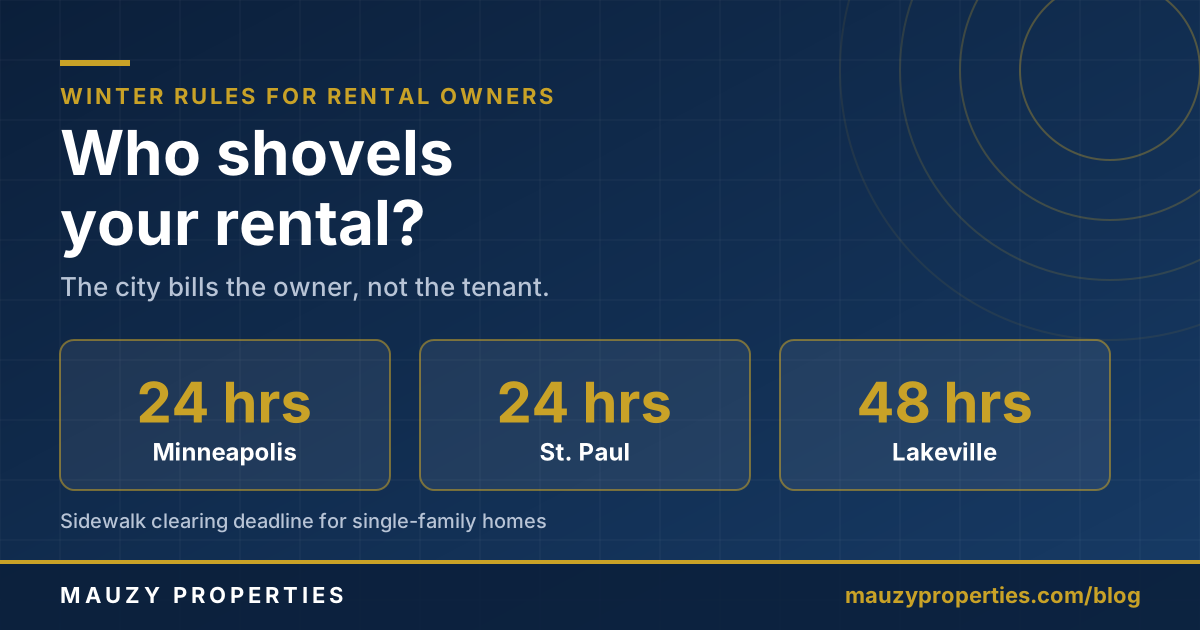
Start with the deadlines. These are the three cities we get asked about most, and they don't match:
| City | Deadline for a single-family home | What happens if it isn't done |
|---|---|---|
| Minneapolis | 24 hours after snowfall ends (Ordinance 445.20) | City inspects starting 24 hours after the snow; crews clear it; owner is billed; unpaid bills go on the property taxes |
| St. Paul | 24 hours after snow and ice stop falling or accumulating (Legislative Code § 113.02) | After a complaint, the city sends the owner a letter, re-inspects usually about 48 hours later, then a city crew clears it at the owner's expense |
| Lakeville | 48 hours after the snow or ice is deposited (City Code § 7-3-8) | Two days' written notice, then the city can clear it and assess the owner; violation is a petty misdemeanor, up to $100, and each day counts as a separate violation |
A few details people miss. Minneapolis wants the full width of the sidewalk cleared to bare pavement along your whole frontage, not a one-shovel-wide path. Corner lots have to clear the curb cuts down to the gutter. Snow goes in your yard or boulevard, not into the street or alley. And if ice won't come up, you sand it until it can. Minneapolis also says plainly that the obligation runs all winter: ice that melts off a neighbor's walk and refreezes on yours is yours.
If your rental is in another suburb, check that city's code. Deadlines and enforcement vary, and "my last rental was in Lakeville" doesn't help you in Minneapolis.
The city bills the owner, not the tenant
Every one of these ordinances runs against the property. Minneapolis says it directly: property owners are required to clear sidewalks. Lakeville makes it unlawful for "the owner or the occupant" to leave it, but when the city clears the walk, it assesses the owner. St. Paul's crews clear it "at the property owner's expense."
So even a well-written tenant-shoveling clause is, at best, a right to get reimbursed by your tenant. If your tenant is out of town for a week in January, or just doesn't do it, the bill comes to you, and in Minneapolis an unpaid one shows up on your tax statement.
What Minnesota law lets you hand to a tenant
Minnesota Statute 504B.161 is the landlord's repair-and-maintenance statute. It's the same section that holds the 68-degree heat requirement, and it has two parts that matter here.
Subdivision 1 lists covenants you can't waive. The landlord covenants that the premises are fit for their intended use, kept in reasonable repair, and kept in compliance with applicable health and safety laws, including local ones. The statute says the parties "may not waive or modify" those covenants.
Subdivision 2 is the exception that permits a tenant to undertake specified work. A landlord can agree with a tenant that the tenant will perform specified repairs or maintenance, but only if the agreement is:
- Supported by adequate consideration. The tenant has to get something for it. The Minnesota Attorney General's landlord-tenant handbook describes this as a rent reduction or a direct payment from the landlord.
- Set forth in a conspicuous writing. Not a sentence in the middle of the boilerplate. Something a tenant would actually notice and understand they agreed to.
And even a valid subdivision 2 agreement doesn't waive the subdivision 1 covenants or relieve the landlord of the obligation to maintain common areas. St. Paul owners have a few more city rules to plan around, from rent stabilization to repair deadlines. See our St. Paul property management page.
Read those together, and the practical takeaway is this: a shoveling clause puts the work on the tenant. It doesn't transfer your legal responsibility for the property to them. That's the honest way to think about it, and it's why the rest of this post focuses on writing the clause well while still having a backup plan.
What "adequate consideration" looks like in real numbers
This is where most do-it-yourself leases fall short. "Tenant is responsible for snow removal" with no rent adjustment is the clause most likely to be challenged if it ever matters, because there's nothing on the other side of the deal.
There are three ways owners usually handle it:
Option 1: A stated rent credit. The lease says rent is $X, which includes a $Y monthly credit in exchange for the tenant's snow and ice removal from November through March. Say the credit is $40 a month. Over five months, that's $200 for the season. It's cheap, it's clear, and it's in writing.
Option 2: Price it into the listing and say so. If the home's market rent is $2,300, you can list at $2,300 with tenant-provided snow removal spelled out, or at $2,350 with owner-provided snow service. The difference is the consideration, and the lease should show it.
Option 3: The owner hires it. You contract with a snow service and either absorb the cost or build it into the rent. Here's the math to run, using your own quotes: if a local service charges $60 per visit and triggers at two inches, and your area sees 12 qualifying events in a season, that's $720. A $40-a-month credit for five months is $200. The gap between those two numbers is the price of control: with a contractor, you know it'll be done by the deadline, you have a dated service record if anyone ever asks, and you're not relying on a tenant's work schedule.
Those per-visit and event figures are placeholders; get two real quotes for your address. Whatever you choose, the consideration has to exist, and the lease has to say what it is.
What the clause should actually say
If you're handing snow removal over to a tenant, a vague clause is almost as bad as no clause. Here's what we'd want spelled out, in its own clearly labeled section, initialed separately:
- The deadline. Tie it to the strictest rule that applies to the property, which for Minneapolis and St. Paul is 24 hours after snowfall ends. Don't write "promptly."
- The areas. Public sidewalk along the full frontage and full width, the driveway, the front walk and steps, and the path to the mailbox and garbage carts. Corner lots: curb cuts to the gutter.
- Ice. Who supplies ice melt or sand? Supplying it yourself is cheap and removes an excuse.
- Absences. If the tenant will be away during the season, they arrange coverage or notify the owner in advance.
- What happens if it isn't done? The owner may hire the work and bill the tenant the actual cost, and any city charges the owner pays due to non-clearing are reimbursable.
- What stays with the owner. Roof snow, ice dams, gutters, and anything structural. Those aren't tenant chores, and you don't want a tenant on a ladder in January.
- The consideration. The dollar amount of the credit or the rent difference, written down.
Have your attorney review the language before you use it. The statute's "conspicuous writing" requirement is a judgment call, and an attorney who does landlord-tenant work in Minnesota will know how courts have treated it.
When you shouldn't hand it off at all
Some situations call for the owner to own snow removal outright, regardless of what the lease could say:
- A vacant house. Between tenants, there's no one to delegate to, and an unshoveled walk is a billboard that nobody's home. If you're carrying a vacant rental in winter, add snow service to the carrying cost.
- A tenant who physically can't do it. If a tenant tells you up front that shoveling isn't realistic for them, a clause they can't perform just sets up a dispute. Price in a service instead.
- Duplexes with shared walks. When two households share the frontage, "tenant shovels" turns into "each assumes the other one will." Assign it to one party or hire it.
Honest caveats
A lease clause doesn't change who the city bills. It gives you a contractual right to recover from the tenant, which is only as good as the tenant's willingness to pay.
Liability for a slip-and-fall is fact-specific. Who controlled the area, what caused the ice, how long it had been there, and what the lease said can all matter, and we're not going to pretend a blog post can tell you how a particular claim would come out. Call your insurance agent and confirm your landlord policy's premises liability coverage and limits, and ask whether an umbrella policy makes sense for your situation. It's also reasonable to require tenants to carry renters insurance with liability coverage, but don't treat that as a substitute for your own coverage.
City rules change. Minneapolis has studied city-led sidewalk clearing and runs a limited-availability pilot that helps some residents get their sidewalks cleared, but its current rules still place the duty on property owners. Check your city's page each fall rather than relying on last winter's memory.
And none of this touches the covenants you can't shift. Heat at 68 degrees from October 1 through April 30, reasonable repair, and code compliance remain yours regardless of the lease. In St. Paul, also keep in mind St. Paul's tenant right-to-repair ordinance when repair requests go unanswered.
What we'd tell you if you called
Pull your current lease this week and find the snow clause. If it doesn't name a deadline, list the areas, and state the consideration in dollars, it needs work before the first big storm, not after.
For most single-family owners, we'd lean one of two ways. If the home has a short walk and a tenant who's handled it well before, a clearly written clause with a stated credit and a backup plan is fine. If the property is a corner lot, a long frontage, a duplex, or in Minneapolis or St. Paul where the 24-hour clock is tight and enforcement is active, the contractor math often comes out worth it once you count your own time chasing it and the risk of a city bill.
Either way, write it down, put a number on it, and know who you'll call when the tenant texts you from Arizona the morning after eight inches.
Want the snow question off your plate?
Snow, ice, heat calls at 2 a.m., and the city inspection letters are the parts of owning a rental that wear people out. Our maintenance team and full-service management are built to handle exactly that. See what management costs, or call or message us at 612.367.7848 and we'll look at your lease and your property with you.
Sources: City of Minneapolis, "Sidewalk snow clearing rules" and Ordinance 445.20 (minneapolismn.gov/getting-around/snow/snow-clearing/sidewalk-snow-clearing); City of Minneapolis, "Sidewalk Snow & Ice Clearing Help" (minneapolismn.gov); City of Saint Paul Public Works, "Sidewalk Snow Shoveling" (stpaul.gov/departments/public-works/snow/sidewalk-snow-shoveling) and Saint Paul Legislative Code § 113.02; Lakeville City Code § 7-3-8 (Ord. 573) (codelibrary.amlegal.com/codes/lakevillemn); Minnesota Statutes section 504B.161 (revisor.mn.gov/statutes/cite/504B.161); Minnesota Attorney General, Landlords and Tenants: Rights and Responsibilities, Chapter 2 (ag.state.mn.us/Consumer/Handbooks/LT).
This post is general information about Minnesota rules as of November 2026, not legal, tax, or insurance advice. City ordinances and state law change, and how they apply depends on your property and your lease. Before relying on a lease clause, talk with a Minnesota attorney who handles landlord-tenant matters, and confirm your coverage with your insurance agent.